

61 Million Americans Faced Credit Card Fraud in the Last Year
2026 Credit Card Fraud Report and Statistics
 &
&
 Last Updated on Sep 17, 2026
Key findings
- 61% of U.S. credit card holders have been victims of fraud, and 51% have experienced it multiple times.
- An estimated 61.3 million Americans had fraudulent charges on their credit or debit cards in the past year alone, totaling roughly $6.1 billion in unauthorized purchases.
- Adults over 45 are significantly more likely to be victims of credit card fraud: 70% of respondents aged 45–59 and 69% of those aged 60+ have experienced fraud, compared to just 47% of adults aged 18–29.
- 22% of victims experienced recurring fraudulent charges from the same merchant. nearly double the 12% reported in 2024, confirming a durable “slow-bleed” fraud trend.
- Only 5% of fraudulent charges involved a physically stolen card; the vast majority of fraud occurs remotely through data breaches, skimming, and credential theft.
- 96% of victims recovered their money, yet only 8% reported the fraud to law enforcement, suggesting that most Americans treat credit card fraud as a problem for their bank to solve.
- Risky digital habits remain stubbornly common: 51% of cardholders use the same card for autopay and everyday spending, 43% reuse passwords, and 38% store card info in their browsers.
Credit and debit cards now account for the majority of consumer payments in the United States, and for fraudsters, every transaction is an opportunity. For the fifth consecutive year, we surveyed more than 1,000 U.S. cardholders about their experiences with fraud, their digital habits, and how they respond when unauthorized charges appear.
The 2026 findings show a problem that has plateaued at a troublingly high level. Meanwhile, AI-enabled fraud tactics are advancing rapidly with account takeover attempts having surged 141 percent since 2021. Adding to these concerns, the CFPB’s uncertain future raises questions about what consumer protections will be available going forward.
Credit Card Fraud Victimization Rates (2021–2026)
The share of cardholders who have experienced suspicious transactions two or more times has now reached 51 percent, a level first hit in 2025 and holding steady into 2026. Meanwhile, the percentage who say they’ve experienced fraud only once has dropped to just 10 percent, down from 23 percent in 2021. The implication is clear: if credit card fraud has happened to you once, it’s very likely to happen again.
How many times have you had a suspicious transaction on your credit or debit card(s)?
| Year | Never | Once | Two or more times |
|---|---|---|---|
| 2021 | 42% | 23% | 35% |
| 2022 | 35% | 21% | 44% |
| 2024 | 40% | 15% | 45% |
| 2025 | 37% | 12% | 51% |
| 2026 | 39% | 10% | 51% |
Source: Security.org surveys of U.S. cardholders, 2021-2026
This pattern is consistent with what cybersecurity researchers have documented. Once a card number is compromised in a data breach, that credential circulates across dark web marketplaces for months or even years, leading to repeated unauthorized use. An estimated 1.3 billion consumer records were exposed in 2024 alone through “mega” data breaches, flooding criminal networks with fresh card data.
Zooming in on the past 12 months, roughly one in three adults experienced a fraudulent charge. That translates to an estimated 61.3 million Americans. Their total unauthorized charges amounted to approximately $6.1 billion in just one year. For the second straight year, more than 60 million Americans experienced credit card fraud.
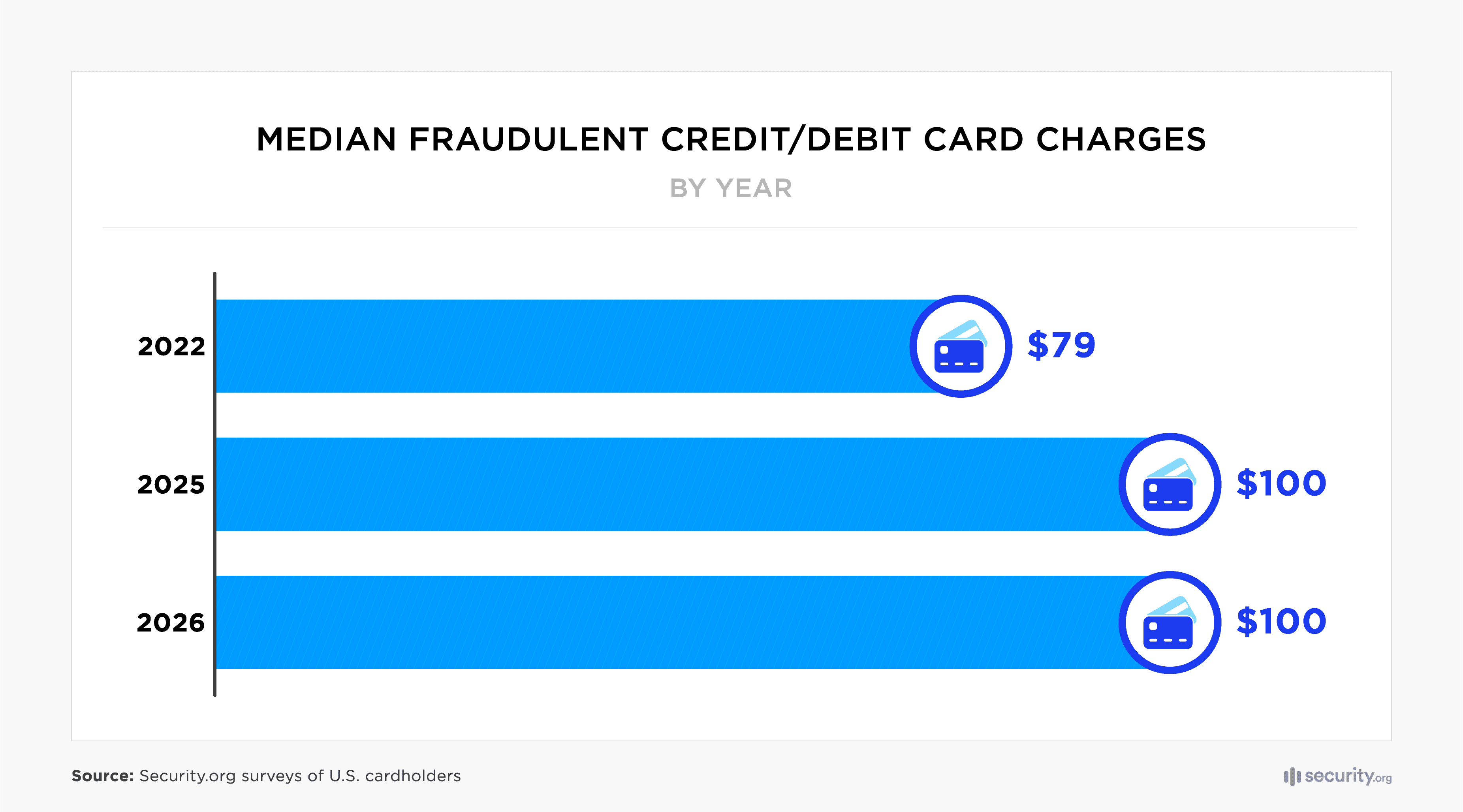 Only five percent of cards had been physically lost or stolen before the fraudulent charges, meaning the overwhelming majority of fraud happens without the criminal ever touching the physical card. Credit card numbers are often compromised through data breaches, skimming, or identity theft. The median fraudulent charge held steady at $100 for two years running, a price point that sits in a dangerous sweet spot: high enough to cause concern, but low enough to blend in with legitimate purchases on a cluttered statement.
Credit Card Fraud by Age Group: Adults Over 45 Most Affected
One of the most interesting findings in this year’s data: younger adults are significantly less likely to have been fraud victims. Adults aged 18–29 were the only age group where a majority (53 percent) had never experienced a suspicious transaction. By contrast, 70 percent of respondents aged 45–59 and 69 percent of those 60 and older reported having been victimized at least once.
| Age group | Percent who’ve experienced credit card fraud |
|---|---|
| 18–29 | 47% |
| 30–44 | 58% |
| 45–59 | 70% |
| 60+ | 69% |
Source: Security.org survey of U.S. cardholders
Cumulative exposure could be the dominant risk factor: more years of card usage mean more merchants, more transactions, and a greater chance that a number will end up in a breach database. Notably, gender had no significant effect on fraud rates, and the number of credit cards held showed no correlation with increased victimization rates. The typical person in our study had three credit cards.
Credit Card Fraud Detection: How Victims Discover Unauthorized Charges
Nearly half (47 percent) of all fraud victims in our study were defrauded within the past 12 months, showing that credit card fraud remains an active, ongoing threat. Among those who were victimized, the majority discovered unauthorized charges relatively quickly.
| How long did it take you to discover the most recent fraudulent charge on your credit card? | Percentage of victims |
|---|---|
| Within minutes | 26% |
| Within hours | 36% |
| Within days | 28% |
| One billing cycle | 7% |
| Multiple billing cycles | 3% |
Source: Security.org survey of U.S. cardholders
A combined 62 percent of victims noticed the charge within hours. This speed is likely driven by the 54 percent of victims who received a call, text, or email alert from their credit card company when a suspicious transaction occurred. Automated monitoring tools are the primary driver of early detection. Still, 10 percent of victims didn’t catch the charge for one or more billing cycles, leaving them exposed to ongoing unauthorized use for weeks or months.
When fraud does occur, the financial system generally makes victims whole. 96 percent of victims reported getting their money back and having charges reversed, and 96 percent reported the fraud to their credit card company. However, fewer than 10 percent reported the fraud to law enforcement, a persistently low figure that suggests Americans overwhelmingly resolve fraud through their card issuer rather than through the justice system.
| Did you report your most recent fraudulent charge? | 2025 | 2026 |
|---|---|---|
| Yes, to my credit card company | 94% | 96% |
| Yes, to law enforcement | 10% | 8% |
Source: Security.org surveys of U.S. cardholders, 2025-2026
The low rate of police reporting has real consequences. Without victim reports, law enforcement agencies lack the data needed to identify fraud rings, pursue prosecutions, and allocate resources. For every 100 people defrauded, only eight tell police.
Recurring Fraudulent Charges: 22% of Victims Report Repeat Billing
Among the most alarming trends in this year’s data: 22 percent of fraud victims have experienced recurring unauthorized charges from the same merchant, nearly double the 12 percent who reported this in 2024. Rather than making a single large purchase, these fraudsters set up small, repeating charges (often disguised as subscriptions or service fees) that can go unnoticed for months.
| Have you ever experienced recurring fraud from the same merchant? | 2024 | 2025 | 2026 |
|---|---|---|---|
| Yes | 12% | 21% | 22% |
| No | 88% | 79% | 78% |
Source: Security.org surveys of U.S. cardholders, 2024-2026
The rise likely reflects the explosion of subscription services, dark-pattern billing practices, and the ease with which stolen card numbers can be used to set up automated payments. A single unauthorized charge is a disruption; a recurring one that runs undetected for months feels like a systemic failure and raises questions about whether current fraud-detection tools are adequate for subscription-heavy commerce.
Consumer Perception of Fraud: 78% of Americans Say It’s Increasing
We asked respondents how they perceive the prevalence of identity theft and fraud in the United States over the past few years. The response was nearly unanimous.
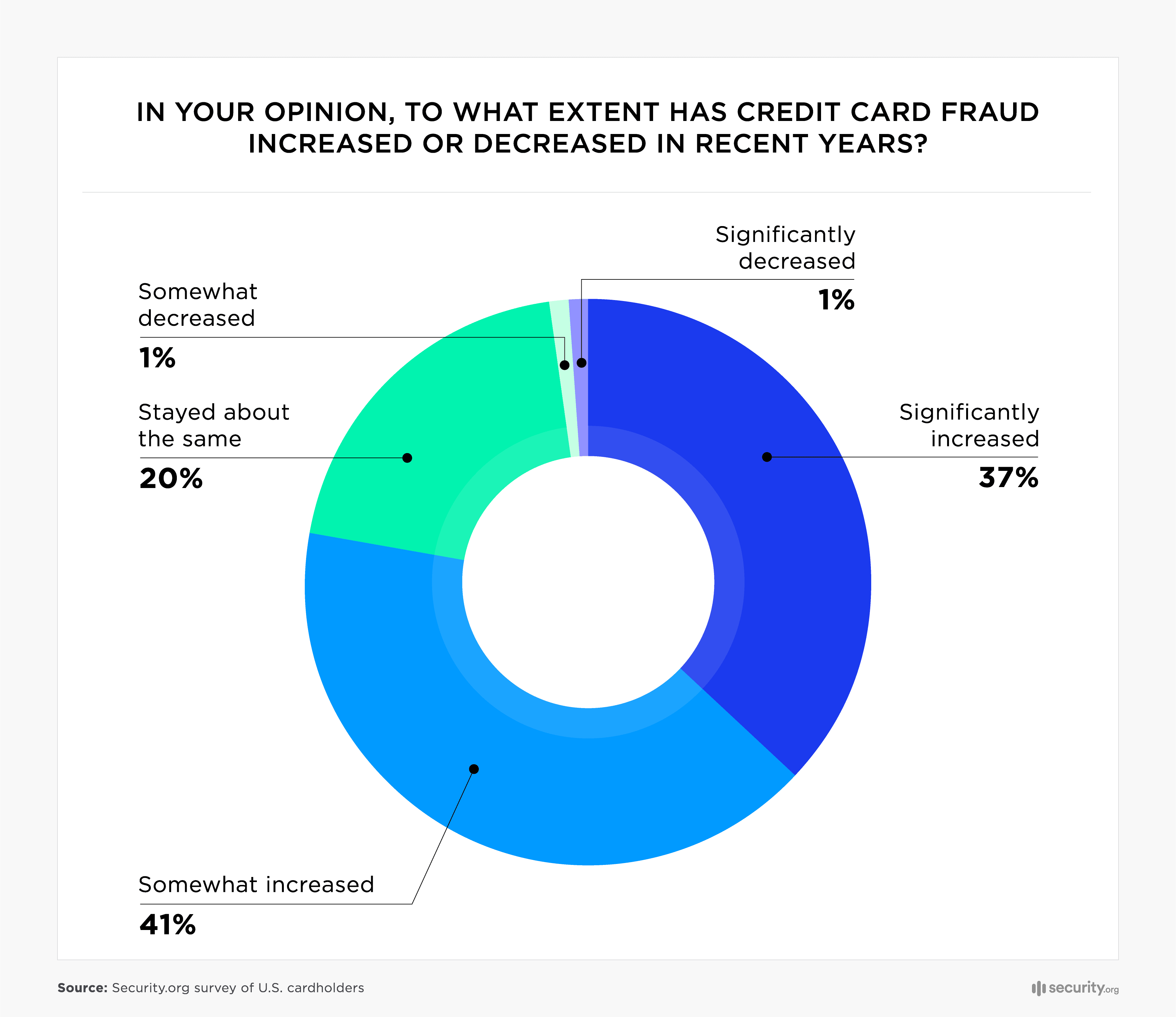
Nearly 80 percent of respondents believe fraud has increased in recent years, with 37 percent describing the increase as significant. Only two percent felt that rates were decreasing. This sentiment is well-supported: FTC data showed that identity theft cases filed in the first quarter of 2025 already exceeded all of 2024. Credit card fraud remains the single most reported form of identity theft in the country, and it’s one of the rare issues where Americans across demographics agree the problem is getting worse.
Credit Card Security Habits Among U.S. Cardholders
With billions of dollars at stake, financial fraudsters have grown increasingly resourceful. Clever criminals employ a toolbox of tactics to hijack accounts through AI-powered phishing emails, skimming devices, malware, and credentials leaked in data breaches. While consumers can’t control every threat, we found that their everyday habits can affect their security.
Common Risky Credit Card Habits
Despite years of high-profile data breaches and widespread fraud, some risky digital habits remain stubbornly common among American cardholders. Fortunately, other bad habits have become less common.
| Risky habits | 2022 | 2024 | 2025 | 2026 |
|---|---|---|---|---|
| Use the same credit cards for autopay and everyday spending | 58% | 52% | 54% | 51% |
| Use the same password for more than one online account | 50% | 40% | 48% | 43% |
| Store credit card info in browsers or on websites | 46% | 41% | 42% | 38% |
| Use public Wi-Fi connections | 42% | 34% | 39% | 34% |
| Use a free VPN | 10% | 8% | 10% | 11% |
Source: Security.org surveys of U.S. cardholders, 2022-2026
More than half of cardholders (51 percent) still use the same card for autopay subscriptions and daily purchases, creating a single point of failure. If that one card number is compromised, every account linked to it is exposed. Nearly half (43 percent) reuse passwords across multiple online accounts, meaning a single breach can cascade into access across banking, shopping, and email accounts. And more than a third (38 percent) store their card information directly in web browsers or on merchant websites, where it’s vulnerable to malware and credential-harvesting attacks.
Experts recommend separating daily-use cards from cards designated for recurring payments. Splitting transaction types limits your exposure and makes it a lot easier to spot something suspicious. We also recommend using digital wallets like Apple Pay or Google Pay. They transmit encrypted tokens instead of your actual card number to process payments. You should also learn how to identify card skimmers at point-of-sale terminals, and always cover your PIN when inputting it in public.
Protective Security Practices and Adoption Rates
On the protective side, the standout trend is the continued growth of multi-factor authentication, which has surged from 55 percent adoption in 2024 to 66 percent in 2026, an 11-point climb in just two years, likely driven by card issuers making biometric login a default option. Other protective habits, however, have largely flatlined.
| Safe habits | 2024 | 2025 | 2026 |
|---|---|---|---|
| Regularly review credit card statements | 79% | 78% | 77% |
| Use multi-factor authentication or Face ID for card accounts | 55% | 63% | 66% |
| Subscribe to email/text alerts for credit and debit cards | 61% | 62% | 62% |
| Use an online password manager | 37% | 37% | 40% |
| Subscribe to a credit monitoring service | 31% | 36% | 32% |
Source: Security.org surveys of U.S. cardholders, 2024-2026
Reviewing credit card statements remains the most widely practiced precaution at 77 percent, followed by transaction alerts and password managers. Setting up spending alerts may be the single most important step a cardholder can take: 54 percent of recent fraud victims said they received a notification from their card company about a suspicious transaction, and 62 percent of victims discovered the unauthorized charges within hours.
Credit Card Fraud Outlook
Though credit card fraud rates have stabilized in the past few years of our research, it does not mean the problem has peaked. In fact, that equilibrium masks real costs: the hours victims spent resolving disputes, the anxiety of violation, and a growing sophistication in fraud tactics that could overwhelm current defenses. Recurring fraud is likely to accelerate as subscription commerce grows. AI-enabled scams like deepfake calls, synthetic phishing, and credential-testing bots are also already being deployed at scale against everyday cardholders.
In the meantime, basic digital hygiene habits still matter. To lower your risk of credit card fraud and its financial consequences, set up transaction alerts on your credit or debit cards. Enable multi-factor authentication on every financial account. Use separate cards for daily purchases and recurring payments, and set unique passwords for every online account. It also pays to review your bank and credit card statements regularly. Even a few minutes each month can mean the difference between catching a fraudulent charge quickly and letting it drain your account for a year.
Methodology
In early 2026, we conducted an online survey of approximately 1,000 U.S. adults who currently hold at least one credit or debit card. Respondents’ ages and genders were representative of the U.S. population based on Census data. Respondents were asked about their perceptions of and experiences with fraudulent credit card charges, as well as their financial security habits. Where applicable, results were compared to our January 2025 survey (~995 respondents) and, where available, to our 2024 and 2022 results to establish multi-year trend lines. Statistical significance testing was conducted across demographic groups; significant differences are noted where applicable. The median number of credit cards held by respondents was three.
Note: The aggregate estimates of 61.3 million Americans affected and $6.1 billion in unauthorized charges are extrapolated from survey data applied to the U.S. cardholder population and should be cited as estimates.