

2026 Package Theft Report and Statistics
An estimated 47.7 million Americans have been victimized by package theft in the last year alone. Learn how to keep your deliveries safe this holiday season.
 &
 Last Updated on Oct 28, 2026
Key Findings
- Three in 10 American adults, or about 80 million people, have had a package stolen at some point, up from 24% in our 2025 survey. Four percent have experienced package theft in just the last three months.
- We estimate that 47.7 million people have been victims in the last year, and their stolen packages were worth $7.7 billion. The average value of respondents’ most recently stolen packages was $161, down from $222 in 2025.
- Nearly half of Americans (49%) worry more about package theft during the holidays, and 37% have hesitated to place an online order because of theft concerns.
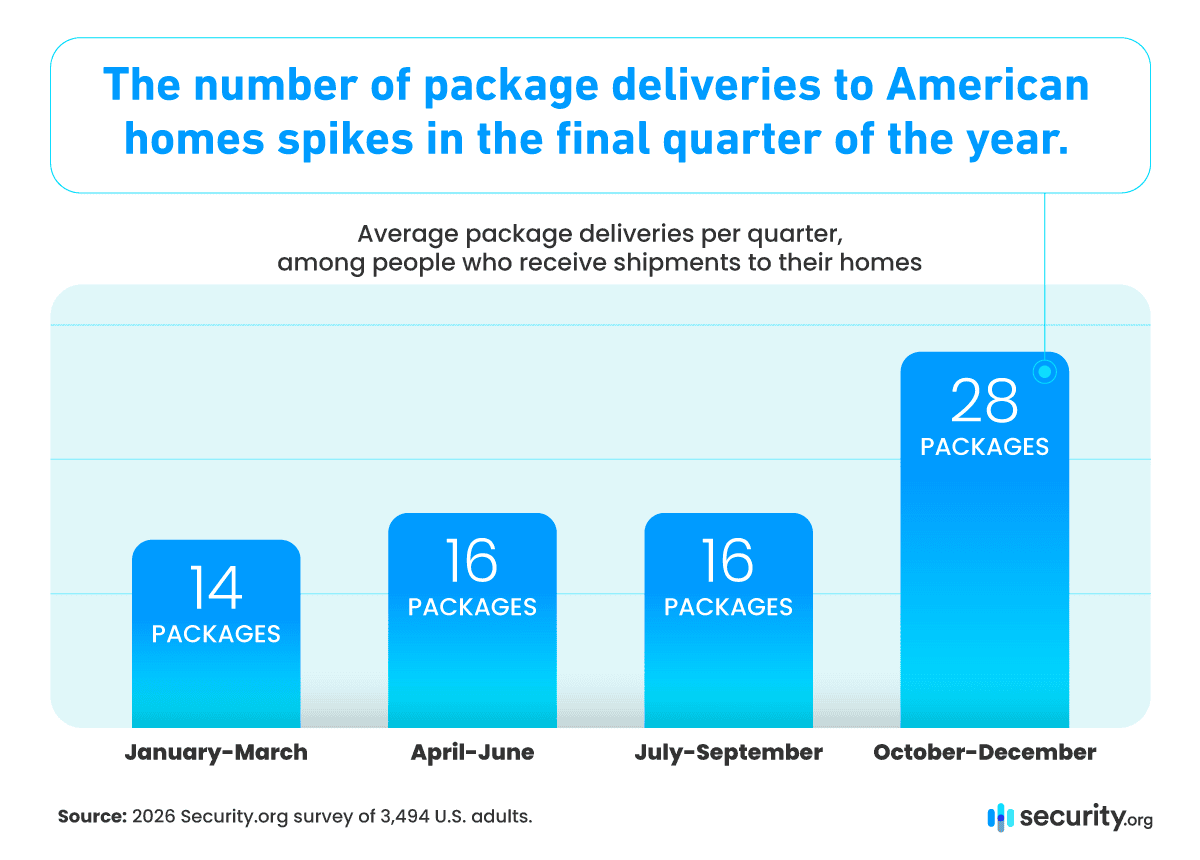
- 14% have had a package containing a gift stolen. With adults expecting 28 deliveries each between October and December, the holiday season brings plenty of opportunities for porch pirates.
- Apartment residents were more than three times as likely to have a package stolen in the past three months (10% versus 3% of single-family home residents). They were also more likely to hesitate before ordering online because of theft concerns (48% versus 34%).
- Fewer than one in four package theft victims reported their most recent theft to police, but experts recommend reporting all stolen packages, regardless of value.
Americans are hooked on online shopping, and this holiday season is shaping up to be the biggest yet. Adobe projects $275.1 billion in U.S. online spending during November and December, up 6.7% from 2025. Having every gift on your list shipped straight to your door during the busy holiday season is convenient, but it’s also a boon for porch pirates.
Porch pirates are gift-stealing Grinches who can snatch packages worth hundreds of dollars from porches and mailboxes as Christmas and Hanukkah get closer. Even though new home security technology has made it easier to monitor deliveries, nearly half of Americans worry more about package theft during the holidays than any other time of year.
We’ve been tracking package theft trends for over five years, and this year we surveyed nearly 3,500 Americans about their online shopping habits, experiences with stolen packages, and what they’re doing to keep their deliveries safe. We’ve also put together expert tips to make sure your gifts don’t end up in the wrong hands this holiday season. We hope sharing package theft rates helps you feel more in control and confident protecting your deliveries.
Expert Security Tip : From Gene Petrino, former S.W.A.T. commander and police sergeant
“My number one package theft tip is to eliminate opportunity. Thieves can’t steal what they can’t see. Have packages delivered to a secure location—like an Amazon Locker, UPS Access Point, or your workplace—or schedule deliveries for times when someone is home. Visible security cameras and motion lighting help, but the most effective deterrent is removing the target altogether.”
The Scale of Package Theft
Online shopping started as a fun convenience, but now it’s something Americans truly depend on. Our survey revealed that the average adult receives 74 shipments yearly, which amounts to more than 19 billion deliveries across the country annually.
Unfortunately, some of those packages never reach the people who ordered them. This year, we found that 30% of American adults have had a package stolen at least once in their lives, and 4% have had one stolen in just the last three months.
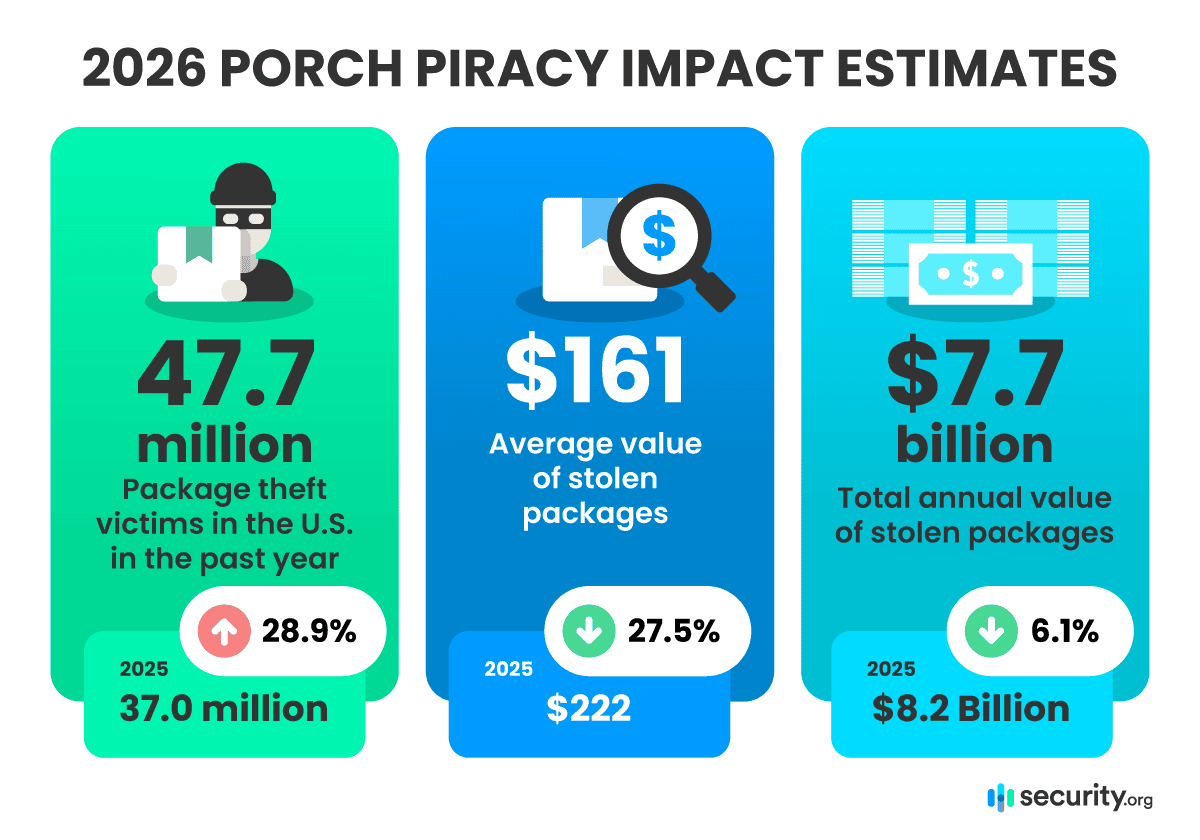 The share of Americans who have ever experienced package theft rose six percentage points since our last survey. While this alone doesn’t mean package theft rates increased, it does indicate the problem hasn’t stopped. Interestingly, the average value of recently stolen packages fell by about 27%, from $222 in 2025 to $161 in 2026. That decline comes as more shoppers turn to lower-cost brands and value retailers while inflation persists, although our survey didn’t directly explore whether bargain hunting contributed to the drop.
Based on our latest survey data, we estimate nearly 48 million package theft victims in the last year, totaling $7.7 billion in the value of recently stolen packages, highlighting the scale of the issue. These figures are extrapolations from three months, not a direct count of thefts over a full year.
Online Shopping and Holiday Delivery Concerns
Our data shows that package deliveries spike as people shift to online shopping for year-end gifts. On average, respondents expect to do about two-thirds (67%) of their 2026 holiday shopping online, with each adult expecting an average of 28 packages between October and December, far higher than in other quarters of the year.
 The biggest sales events will bring a rush of orders. Adobe forecasts $47.5 billion in U.S. online spending during Cyber Week, the five days between Thanksgiving and Cyber Monday. That includes $12.9 billion on Black Friday and $15.1 billion on Cyber Monday. For shoppers, those bargains make a secure delivery plan especially important. This flood of deliveries and the risk of theft make online shoppers nervous. More than one-third of respondents (37%) sometimes hesitate or think twice about an online order because of package theft concerns. Nearly half (49%) worry more about theft during the holidays than during the rest of the year, while only 4% worry less.
| How often do you worry about package theft during the holidays compared with the rest of the year? | Percentage of respondents |
|---|---|
| More often | 49% |
| About the same | 47% |
| Less often | 4% |
Source: 2026 Security.org survey of 3,494 U.S. adults.
Their worry makes sense: 14% of respondents have actually had a package containing a gift for someone else stolen. Losing a delivery is inconvenient year-round, but replacing a rare or custom gift before a holiday can be especially difficult.
Despite these concerns, most people feel just as comfortable ordering online as they did last year. Seventy-seven percent reported no change in their level of concern, while 16% feel more comfortable, and only 7% feel less comfortable.
| Compared with last year, how comfortable do you feel ordering packages online? | Percentage of respondents |
|---|---|
| More comfortable | 16% |
| About the same | 77% |
| Less comfortable | 7% |
Source: 2026 Security.org survey of 3,494 U.S. adults.
Interestingly, apartment residents were more likely to think twice before ordering online: 48% hesitated at least sometimes because of package theft concerns, compared with 34% of people in single-family homes. As we explore later on, this makes sense, as apartment dwellers are more likely to become victims of package theft than those in single-family homes.
Now, let’s look at what people are doing to keep their deliveries safe.
Package Theft Prevention Strategies
As online shopping has grown in popularity, strategies for monitoring and tracking deliveries have also improved. Simple approaches that require direct handoffs from the delivery person to the recipient, such as signing for packages or having them shipped to one’s workplace, are still very effective. Today, artificial intelligence and smart home devices have given us even more options for monitoring deliveries remotely.
Eighty-eight percent of respondents use at least one strategy to prevent package theft, the same figure as in our 2025 research. Like last year, millions of deliveries remain unprotected. Here are some of the most popular methods shoppers employ to keep their packages secure.
| Which of the following strategies, devices, or tools do you currently use to prevent package theft? | Percentage of respondents |
|---|---|
| Schedule shipments for when you are home | 43% |
| Automated delivery notifications or package tracking apps with AI alerts | 38% |
| Doorbell camera with AI alerts (e.g., Ring, Nest, Blink) | 36% |
| Outdoor security camera with motion detection or AI features | 29% |
| Shop in-store or online with in-store pickup | 27% |
| Smart lighting or motion-activated lights | 18% |
| Have neighbors bring packages inside when you’re not home | 17% |
| Have packages shipped to somewhere else besides your home (e.g., workplace, access point) | 12% |
| Have packages delivered to someone else | 8% |
| Security alarm system (not connected to delivery alerts/cameras) | 7% |
| Leave work during lunch/breaks to bring deliveries inside | 7% |
| Smart lock or smart entry system | 6% |
| AI-powered neighborhood or security sharing apps (e.g., Neighbors app, Nextdoor AI alerts) | 4% |
| Use a service that delivers inside your home | 3% |
| None of the above | 12% |
Source: 2026 Security.org survey of 3,494 U.S. adults. Note: Multiple responses allowed.
High-Tech Protection
Thirty-nine percent of respondents use automated delivery notifications or package tracking apps with AI alerts. These tools can help shoppers follow a delivery’s progress and know when it’s time to bring a package inside.
Doorbell cameras with AI alerts are another popular option, used by 36% of respondents. Many popular devices today come equipped with these features, notifying residents as soon as packages arrive. Other common tools include outdoor security cameras and smart lighting. Four percent use AI-powered neighborhood or security sharing apps.
These home security systems and devices can help deter porch pirates, record thefts, or let you unlock your door remotely so someone can place packages inside when you’re not home. By reducing the time a package sits outside, the risk of theft obviously declines. But cameras alone cannot guarantee that a delivery will be safe.
One especially brazen thief made headlines in September 2026. A political canvasser in Woolwich, Maine was recorded allegedly taking a package after knocking on the door and leaving a campaign flier. The doorbell footage showed him looking directly at the camera before picking up the box. The video went viral, and the sheriff’s department said it had identified the suspect and would face charges. In this case, the camera helped document what happened and catch the thief, even though it did not prevent the package from being taken.
Non-Tech Protection
If you don’t have security devices protecting your home, schedule deliveries for when someone will be there, or choose a different delivery location where someone can watch your packages.
About 43% of respondents try to schedule deliveries for when they’re home, and roughly one in four opt to shop in-store or pick up online purchases at actual stores. Others ask neighbors to bring in their boxes or have packages sent to safer places, like work or delivery lockers, to reduce porch exposure.
Respondents who live in apartment buildings were more likely to take certain precautions than those who live in single-family homes. For example, they were nearly twice as likely as single-family home dwellers to have packages shipped somewhere other than home (19% versus 10%), and apartment dwellers were more likely to opt to shop or pick up orders in-store to protect their packages (33% versus 25%).
Who’s Most at Risk of Package Theft?
Package theft experiences vary depending on the type of homes people live in. People in apartment buildings can face particular challenges when deliveries are left in shared spaces, or if their apartment complex lacks a secure package room. Apartment dwellers also may not be allowed to install doorbell or security cameras outside their units, depending on their landlord’s rules.
In our survey, 45% of apartment residents had ever had a package stolen, compared with just 25% of people in single-family homes. That’s a 20-percentage-point gap. Condo residents also reported more lifetime package theft than people in single-family homes.
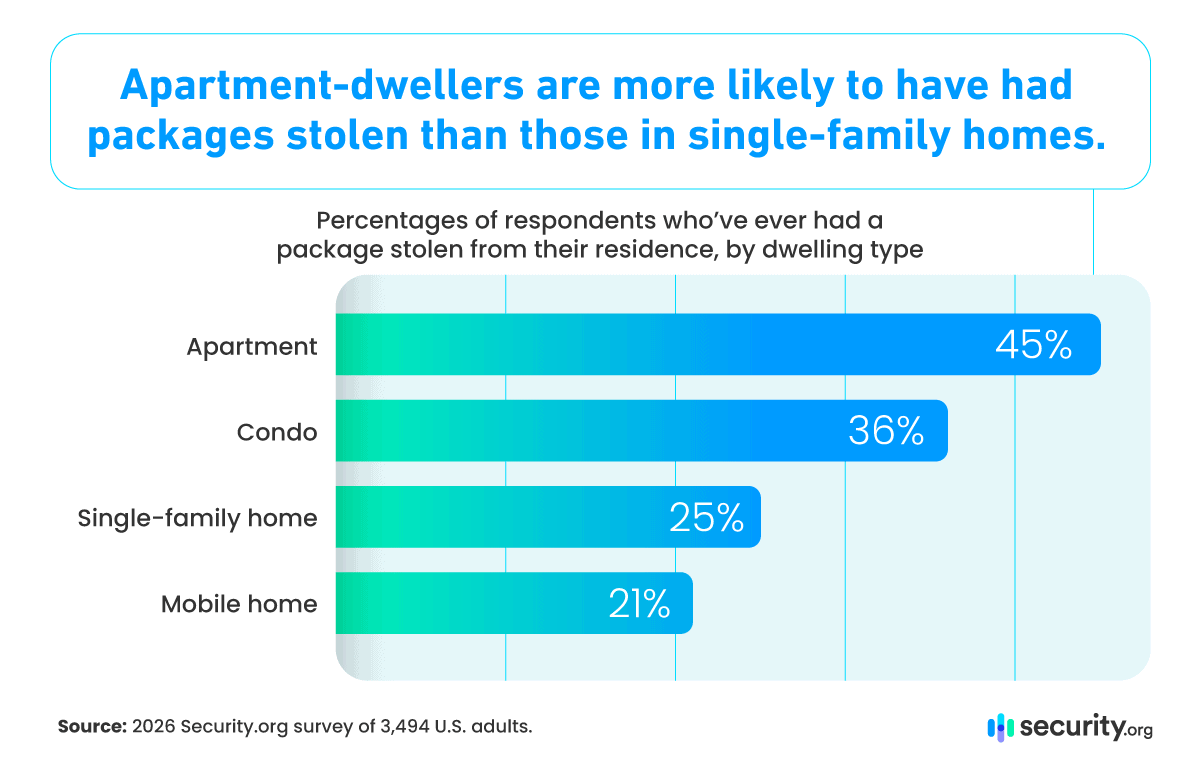 In the past three months alone, 10% of apartment residents had a package stolen, compared with just 3% of those in single-family homes, showing that the gap extends to recent thefts. No matter where you live, reducing the time a package sits unattended can help keep it safe.
When the Package Arrives but Something Is Wrong
Not every delivery problem involves a missing box. A shipment box can reach its destination without the item inside. In June 2026, a UPS driver in Miami-Dade County was accused of stealing a roughly $55,000 Rolex. Investigators said the package arrived at the intended address, but the watch was missing from the box. During a subsequent sting, authorities alleged that the driver opened a bait package containing cellphones, triggering a dye pack that stained his hands red. Investigators later recovered the resealed package from his truck.
While not everyone has experienced the kind of bold-faced theft from the news story above, our survey found that nearly half of respondents (48%) experienced at least one sign of package tampering, missing contents, or a swapped product, even though most said they still found their item safe inside.
| Have you ever experienced these situations when receiving a package? | Percentage of respondents |
|---|---|
| Shipping or product packaging appeared opened, cut, or resealed, but nothing was missing | 34% |
| Shipping box or envelope was empty | 13% |
| Product had been swapped for something else inside its packaging | 10% |
| Product packaging itself was empty | 8% |
| None of the above | 52% |
Source: 2026 Security.org survey of 3,494 U.S. adults. Note: Multiple responses allowed.
Even a delivery notification with a photo of the shipment may not tell the whole story. In Miami, police said surveillance video showed a driver allegedly placing an $849 laptop delivery in a mailroom, photographing it, and then carrying it back to his vehicle. Police arrested the suspect in August 2026 in connection with the July 25 incident.
While stories of shipping employee package theft are alarming, most respondents in our survey were not very worried about it happening to them. 45% of respondents were not at all concerned about delivery personnel stealing packages, and just 5% were very or extremely concerned.
What to Do if You’re a Victim of Package Theft
Even with careful planning, safe delivery spots, and modern home security, anyone can fall victim to porch piracy. If you have a missing package, act fast to confirm whether it was stolen, then quickly report it to retailers, police, and community groups if a crime has occurred.
We recommend taking these steps when you can’t find a package:
Verify the package is missing: Take a deep breath and check its status before you assume it was stolen. Check online tracking, look for delivery notes, or contact the seller or shipper directly. If a package shows as delivered, ask anyone who might have grabbed it for you, such as a family member, neighbor, or doorman. If you think a package was stolen, check security footage, check neighborhood apps, and contact the police to see if others have been affected too.
Tell the seller: Contacting the store for a replacement is usually the fastest next step, especially if you’re racing to replace gifts before the holidays. Have all the key details ready, including your order number, tracking information, delivery date, and any photos or security footage, before reaching out to customer support.
Report the crime to police: Fewer than one in four recent package theft victims (23%) said they reported their latest package theft to police, but filing a report can help law enforcement identify theft patterns in your area. Gene Petrino, a former law enforcement and SWAT commander, strongly encourages reporting. “Even if the dollar amount seems small, these incidents help law enforcement identify crime trends and potential repeat offenders in specific neighborhoods,” he explains. “Package theft is often part of a larger pattern, and reports build the data needed for targeted patrols and prevention. Without those reports, police can’t see the whole picture or allocate resources effectively.”
Look into insurance: If the store or shipper won’t replace or refund your item, check your home insurance policy to see if it covers theft and what your deductible is. Also, contact your credit card company to ask about purchase protection or disputing the charge.
| Where victims reported their most recently stolen package | Percentage of recent package theft victims (last 3 months) |
|---|---|
| Store or company it was purchased from | 60% |
| Delivery company, such as UPS, USPS, or FedEx | 52% |
| Police or law enforcement | 23% |
| Social media | 18% |
| Online neighborhood group or message board | 18% |
| Doorbell camera provider, such as the Amazon Ring app | 15% |
| None of the above | 6% |
Note: Multiple responses allowed.
Tips for Protecting Packages and Holiday Presents
Tips for fighting porch pirates range from common-sense habits to cutting-edge technology. Still, they all come down to a few simple principles: securing your home, getting packages inside quickly, and choosing the optimal delivery location.
Secure your home: If you want packages delivered, there are many ways to protect your property. Smart devices let you monitor and control things remotely from anywhere with an internet connection. Video doorbells, smart locks, security cameras, and motion-activated lights can help deter trespassers and let you manage your delivery area from anywhere. Also, make sure people can see you have security systems. Scaring off pirates is better than catching them in the act.
Get packages inside quickly: Every minute your packages sit outside gives someone another chance to take them. Use tracking updates and delivery notifications to bring purchases inside promptly, or ask a trusted neighbor to help if you’re away.
Ship packages to the safest location: Everyone loves coming home to a package they’ve been waiting for, but giving up a little convenience for better security is worth it if it helps you avoid theft. For example, having packages sent to available friends, family, or neighbors can keep deliveries from sitting unattended. Check whether your workplace accepts personal deliveries, or use delivery lockers where packages are protected until you pick them up.
Shop online and pick up in store: When you find online deals with a physical store, you can buy with a click and pick up items in person, maybe even with quick curbside pickup. Look into your options, especially for valuable purchases or gifts you can’t easily replace.
Methodology
Between September 22 and September 24, 2026, Security.org collected online responses from 3,494 American adults about their online shopping habits, package theft experiences, and delivery concerns. The survey examined both lifetime package theft and theft within the preceding three months. Of the 3,494 respondents, 3,479 received shipments at home at least sometimes.
We selected respondents to align with the U.S. population by age, sex, and geographic region, using the 2020 U.S. Census as a benchmark. No weighting was applied, and each respondent contributed equally to the survey estimates.
For a simple random sample of this size, the conventional margin of error for full-sample percentages would be approximately ±1.66 percentage points at the 95% confidence level. That benchmark does not account for potential bias from online recruitment. Findings based on smaller groups have greater uncertainty, and this benchmark does not apply to averages or medians, including stolen package values.
The supplied national estimates extrapolate the three-month theft victimization rate to the U.S. adult population, multiply by four to annualize it, and use the average value of recent victims’ most recently stolen package to estimate losses. These are annualized survey estimates, not a direct count of stolen packages. The calculation assumes the surveyed three-month period represents the rest of the year and does not fully capture differences in the number or value of packages stolen from each victim.