

2026 Smart Glasses Market Report and Adoption Statistics
An estimated 5% of U.S. adults own a pair of smart glasses, but price and privacy concerns are stopping many Americans from adopting the wearable devices.
 &
&
 Last Updated on Aug 13, 2026
Key Findings
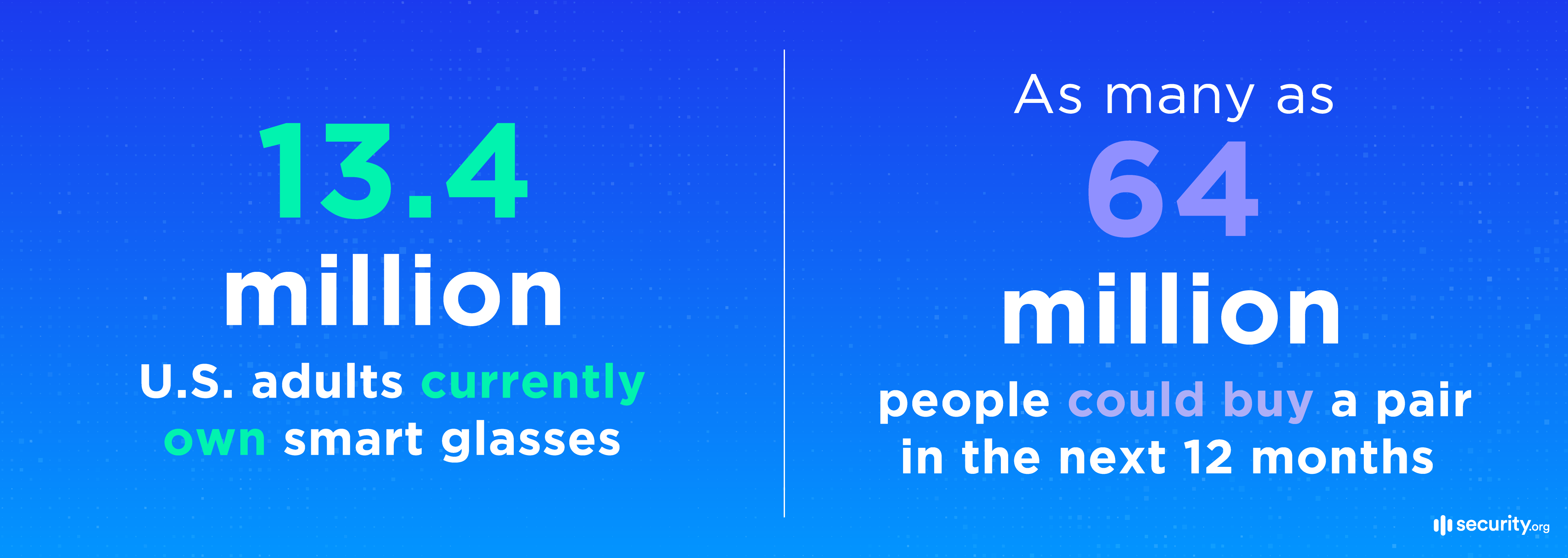
- Roughly 5% of U.S. adults, about 13.4 million people, currently own smart glasses with a built-in camera. Ownership is highest among adults 30 to 44 and among men.
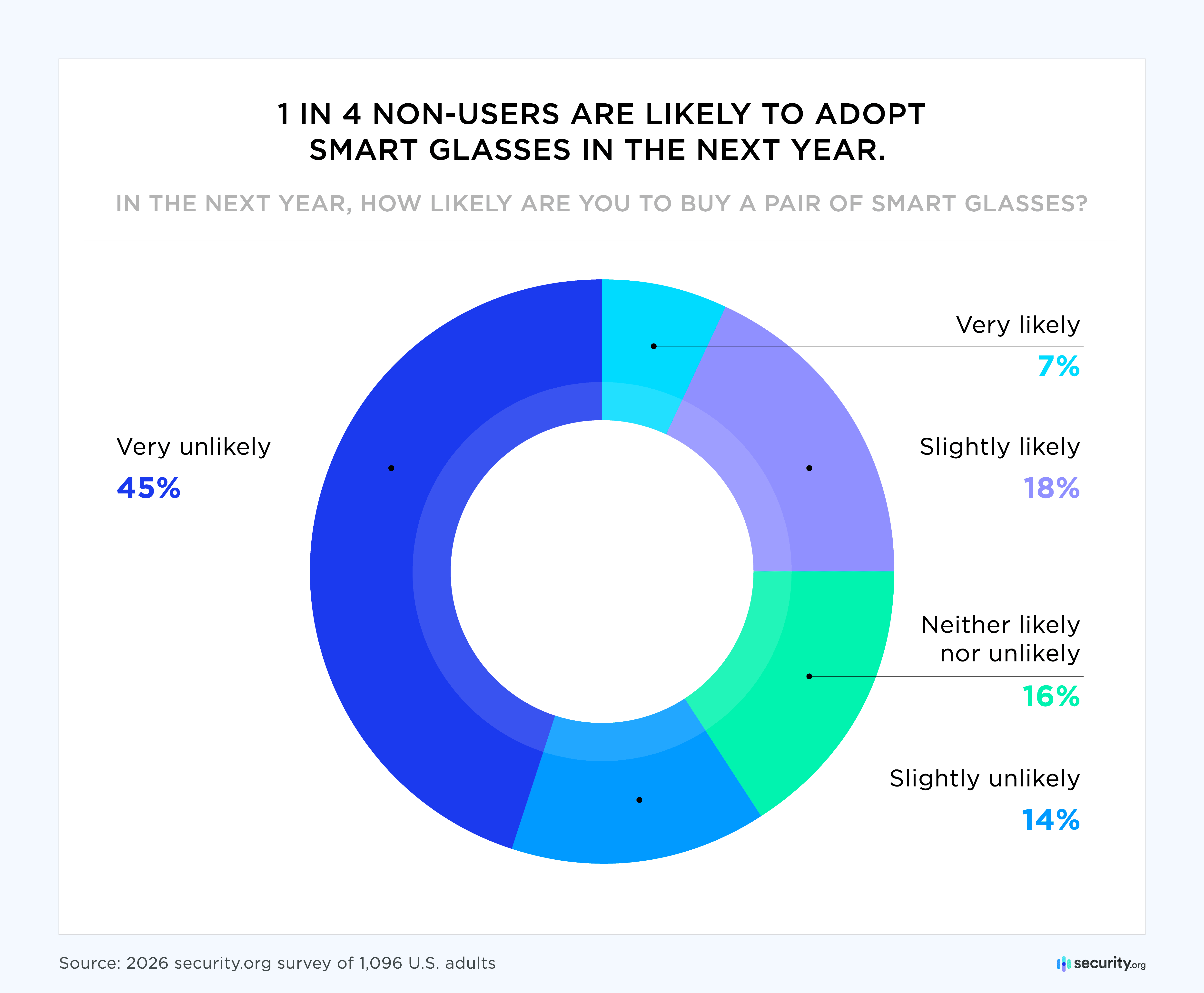
- Market growth could be on the horizon: 25% of non-users say they’re likely to buy glasses in the next year, though 45% say they’re unlikely to obtain a pair.
- Among users, the most popular features are hands-free photo or video recording, audio playback, and AI assistant features. About 25% use the glasses for true vision correction.
- Women were more likely than men to harbor privacy concerns about smart glasses: 78% of women were concerned about secret recordings, compared with 65% of men, and 80% of women were concerned about facial recognition, compared with 70% of men.
- Young adults aged 18-29 were twice as likely as the general population to say the existence of camera-equipped smart glasses has led them to adjust their behavior in public.
- 85 percent of adults favor a law requiring smart glasses to show a visual indicator when recording, with 63% strongly in favor.
Camera-equipped smart glasses have moved quickly from novelty to mainstream. In June 2026, Meta introduced a lower-priced line of AI glasses starting at $299, roughly $80 less than Ray-Ban’s Meta glasses, widening the pool of both owners and bystanders. The rollout is as much a fashion play as a tech launch: the new lineup spans 26 styles and includes a $399 frame designed with Kylie Jenner, part of a celebrity-driven marketing effort aimed to influence mainstream buyers.
At the same time, lawmakers and courts have begun to address privacy issues raised by this new category of wearable tech: New York will bar recording-capable eyewear from all of its more than 1,240 courthouses beginning July 20, 2026, and a Pennsylvania bill would require smart glasses to display a visible recording light.
To understand the American public’s attitude toward smart glasses, Security.org surveyed more than 1,000 U.S. adults in 2026 about their awareness of smart glasses, their reasons for buying or avoiding them, and their privacy concerns. The results show a category that is gaining users while unsettling the public that has to share space with them.
Awareness and Adoption of Smart Glasses in 2026
Overall, relatively few people have adopted smart glasses in the United States today. About five percent of U.S. adults currently own smart glasses with a camera, which works out to roughly 13.4 million people. Ownership is skewed toward male users, and the ownership rate is highest among adults 30 to 44 and lowest among those 60 and older.
Awareness runs well ahead of ownership. Seven in 10 adults (71 percent) were at least somewhat familiar with camera smart glasses before taking the survey, and only five percent had never heard of them. So the gap between knowing about the devices and buying them is not about awareness. As we’ll explore later, resistance to smart glasses adoption is mostly about cost and data privacy concerns.
The intent pool is worth watching, but so is the resistance. Among people who do not currently own a pair, 25 percent say they are at least slightly likely to buy one in the next year, while 59 percent say they are unlikely to do so. By our estimates, as many as 64 million people in the U.S. could buy smart glasses over the next 12 months.
Though most Americans have heard of smart glasses, fewer felt like they’d be able to spot them in use or distinguish them from regular glasses. Only 20 percent of adults say they are very confident they could recognize smart glasses being worn in public, and 22 percent are not at all confident. Confidence falls sharply with age: 66 percent of adults 18 to 29 are at least somewhat confident, compared with 29 percent of those 60 and older. Digital privacy advocates have argued that smart glasses are designed to be nearly invisible to bystanders compared with a phone held up to film, and our recognition data suggests most of the public would agree.
Why Early Adopters Have Embraced Smart Glasses
To learn why owners buy in and how they use their smart glasses, we studied a dedicated sample of smart-glasses owners. Because owners are a small share of any general sample, we surveyed additional owners to ensure this group was large enough to study (103 owners in total). The results below describe the owner group and are not meant to represent all U.S. owners.
Owners bought in for everyday utility and content creation. The most important features when deciding to buy were hands-free video and photos, audio playback, calls, and an AI assistant. True vision correction and pure novelty ranked lower on the list.
| Which of the following features, if any, were important to you when deciding to get a pair of smart glasses? | Share of owners |
|---|---|
| Hands-free videos | 52% |
| Hands-free photos | 48% |
| Listen to audio | 47% |
| Hands-free audio recording | 45% |
| Make phone calls | 41% |
| AI assistant | 40% |
| Language translation | 26% |
| Vision correction | 25% |
| Novelty | 22% |
| Directions, maps, GPS | 21% |
| Always-on video or AI memory | 19% |
| Accessibility support (low vision, blindness, hearing loss) | 8% |
| VR or AR experience and gaming | 8% |
Source: 2026 security.org survey of 103 smart glasses owners. Multiple responses allowed.
The ways people use smart glasses today are diverse and creative: our survey respondents described a blind user whose glasses narrated the scene around him, a golfer who snapped a photo with a voice command, and even a pastor who recorded baptisms from his own perspective. Though most users are far from nefarious, few are consistently disclosing to others when they take recordings with their smart glasses: only four percent of owners say they always tell nearby people when they are recording, and nearly a quarter never disclose when they are recording.
| When recording in public, how often do you disclose that you’re recording to people nearby? | Share of owners |
|---|---|
| Always | 4% |
| Often | 7% |
| Sometimes | 31% |
| Rarely | 23% |
| Never | 23% |
| I do not use my glasses to record in public | 12% |
Source: 2026 security.org survey of 103 smart glasses owners.
That gap matters because it is the behavioral mirror of the bystander anxiety documented later in this report. It also violates the law in some places. A legal analysis from Purdue Global Law School notes that 11 states require all-party consent to record a conversation, which means undisclosed audio capture can raise legal questions well before any facial-recognition feature is added. Owners are not oblivious to the friction. More than a third (36 percent) have disabled a feature for privacy reasons, and one in five (20 percent) has drawn a negative reaction from someone else while wearing the glasses in public.
The Features People Want in Smart Glasses, and the Barriers Holding Them Back
Among people who do not yet own a pair of smart glasses, the appeal is practical. Hands-free photos top the list, but corrective lenses and turn-by-turn directions are close behind, a sign the next wave of buyers may want glasses that are truly glasses first and cameras second. Notably, more people were interested in smart glasses for vision correction and navigation than were current smart-glass owners.
| Which of the following features, if any, are most appealing to you in a pair of smart glasses? | Share of non-owners |
|---|---|
| Hands-free photos | 45% |
| Vision correction | 41% |
| Hands-free videos | 40% |
| Directions, maps, GPS | 40% |
| Language translation | 38% |
| Listen to audio | 34% |
| Make phone calls | 31% |
| Hands-free audio recording | 30% |
| AI assistant | 29% |
| VR or AR experience and gaming | 19% |
| Accessibility support (low vision, blindness, hearing loss) | 18% |
| Always-on video or AI memory | 17% |
| Novelty | 16% |
| None of the above | 11% |
Source: 2026 security.org survey of 1,096 U.S. adults. Multiple responses allowed.
Two barriers stand out among people who are not likely to buy smart glasses: price and privacy. Cost is the most common purchase barrier overall, but privacy is a close, telling second, and the age pattern within it is notable. Concern about privacy as a reason not to buy runs highest among the youngest adults and declines with age, which aligns with other research showing that younger adults are often more privacy-conscious than their elders.
| Which of the following reasons contributed to your decision not to buy smart glasses? | Percentage of people not likely to purchase glasses |
|---|---|
| The price | 67% |
| Privacy concerns | 56% |
| I don’t see the usefulness | 43% |
| I don’t know enough about them | 23% |
| Their appearance | 19% |
| Their fit or comfort | 8% |
Source: 2026 security.org survey of 1,096 U.S. adults. Multiple responses allowed.
Meta’s newer, cheaper line of smart glasses could directly attack the price barrier. Still, it does nothing to address the privacy barrier, which is intensifying among young, high-intent buyers who will define the next phase of adoption.
Smart Glasses and Data Privacy Concerns
Concern about covert recording is broad, and concern about facial recognition is broader still. Part of what makes the devices feel risky to some is how ordinary they look while recording. “Smart glasses can film anything that is in plain sight,” including credit card numbers, passwords, and keystrokes typed in front of someone wearing them, says Tom Clayton, COO and president of Aura. He notes that this makes old-fashioned shoulder surfing “more seamless and streamlined” for fraudsters, since the footage uploads instantly and can be used to commit identity theft or financial fraud.
The risk compounds when that footage is combined with other data. “When images are correlated with sound or other data, the recordings can reveal a lot of information about the people who are recorded,” including their identities, routines, and relationships, says TK Kitts, chief investigator at Redbeard Intelligence and Investigations, who notes that the combination could enable stalking, doxxing, and even corporate espionage.
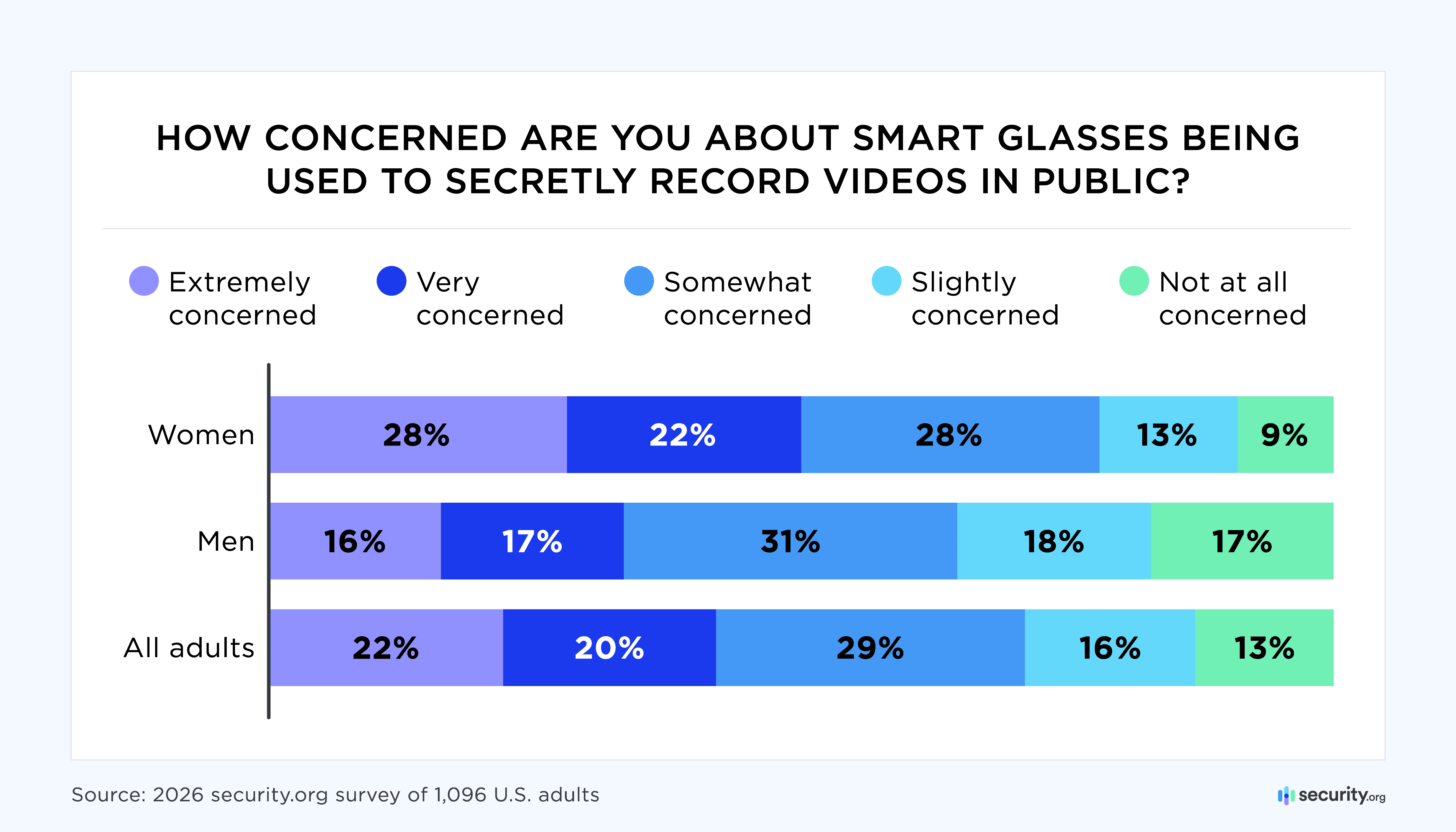
Across all adults, 72 percent are at least somewhat worried about being secretly recorded in public, and the worry is not evenly distributed across genders. Women are significantly more concerned than men, and they register more of the most intense worry.
The gender gap is not abstract. It maps onto documented cases of women being filmed without consent. CNN has reported on a trend of men covertly filming women during staged encounters and posting the clips online, coverage that also noted a joint letter from more than 70 civil-liberties groups urging Meta to abandon facial-recognition plans. Concern about that specific feature was one of the key privacy concerns in our survey.
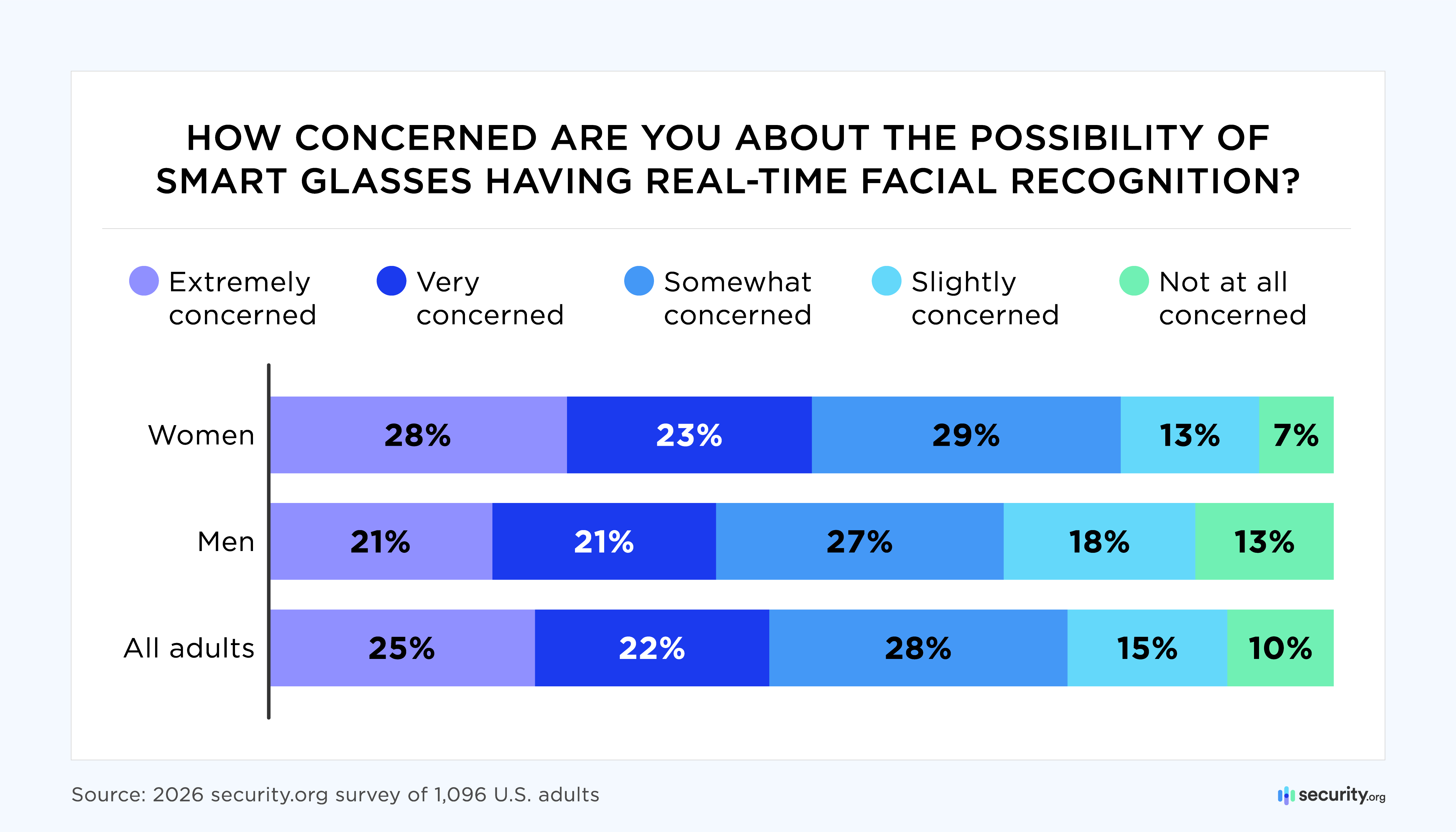
Two Harvard students demonstrated that live footage from Ray-Ban Meta glasses could be paired with publicly available facial recognition tools to identify strangers within seconds. Against that backdrop, trust in the companies making the devices is low. Six in 10 adults distrust manufacturers to use best practices for video and data privacy, and only three percent strongly trust them.
| To what extent do you trust smart-glasses manufacturers to use best practices for video and data privacy? | Women | Men | All adults |
|---|---|---|---|
| Distrust (net) | 64% | 56% | 60% |
| Neutral | 19% | 24% | 22% |
| Trust (net) | 17% | 20% | 19% |
Source: 2026 security.org survey of 1,096 U.S. adults.
Despite widespread concern, most people have not changed their behavior in public out of fear of being recorded by smart glasses. Only eight percent of all adults say smart glasses have altered their behavior, and such changes were more likely among the young: 15 percent of adults aged 18-29 have changed their behavior as smart glasses have risen in popularity.
Among the minority who have changed, some describe real disruption. In their own words, respondents reported dressing more conservatively, masking in crowds, and ordering anti-facial-recognition coatings for their lenses. One wrote that the sense of being watched was making her “increasingly agoraphobic.” These are individual accounts rather than population rates, but they put a human face on the numbers, and they help explain why support for regulation is so strong.
What the Public Wants Next
Part of the public’s unease comes from a lack of legal protections surrounding smart glasses. “There’s no reasonable expectation of privacy in public,” says Karis McLarty, a certified information privacy professional and head of Kroll’s Corporate Compliance and Business Ethics practice.
Against that backdrop, survey respondents have a clear, specific ask. A clear 85 percent of adults favor a law requiring smart glasses to display a visual indicator when recording, and 63 percent strongly favor it. Only four percent are opposed. Women, the group most worried about covert recording, back this type of law most strongly.
| How would you feel about a law requiring smart glasses to have a visual indicator when recording? | Women | Men | All adults |
|---|---|---|---|
| Strongly in favor | 71% | 55% | 63% |
| Somewhat in favor | 19% | 25% | 22% |
| Neither in favor nor against | 7% | 15% | 11% |
| Somewhat against | 2% | 3% | 3% |
| Strongly against | 1% | 2% | 1% |
Source: 2026 security.org survey of 1,096 U.S. adults.
The public is already ahead of the legislature on this specific point. Pennsylvania’s House Bill 2603 would require a visible, non-disableable recording indicator to be folded into the state’s existing wiretapping law. New York has already taken a different route, banning recording-capable eyewear from every court in the state as of July 20, 2026, the first statewide ban of its kind.
Between near-universal support for an indicator light and the emergence of venue bans, the likeliest near-term path may be place-by-place restrictions in sensitive settings such as courts, medical offices, and locker rooms, rather than a single national mandate for a feature.
How to Protect Your Privacy From Smart Glasses
Since laws and regulations are still catching up, we asked privacy and security professionals what people can do right now to improve their privacy, whether they own a pair of smart glasses or spend time around people who do. We paired their advice with steps grounded in our own data.
- Limit the glasses’ permissions, or use them offline. “I highly recommend limiting as many permissions as possible to restrict the amount of information being voluntarily sent to servers and third parties,” says TK Kitts, chief investigator at Redbeard Intelligence and Investigations. “If an offline mode is available on your particular pair of smart glasses, choosing to keep the glasses offline will ensure your data is not sent to the cloud.”
- Know that consent doesn’t apply in public spaces. “Consent is not necessary to film someone in public,” says Paul Bischoff, consumer privacy advocate at Comparitech. His practical advice: keep sensitive documents and screens out of view, since you can’t stop someone from photographing or filming you on a public sidewalk. However, if someone is filming inside a business or home, there could be more protections. “If it’s on private property, contact the property owner and ask them to enforce whatever rules they have about cameras,” Bischoff says.
- Use a data-removal service to limit what’s exposed. Shoulder surfing through smart glasses works best when a fraudster can pair a stolen glimpse of your information with other details already floating online, according to Aura’s Tom Clayton. In our survey, 12 percent had used a data-removal service, up from 6 percent in our earlier research, and these tools cut down what’s available to piece together in the first place.
- Pursue community-level reforms. “I think that the only kind of truly effective response will have to come not at the individual level but through group efforts,” says Irina Raicu, director of the Internet Ethics Program at Santa Clara University. “Businesses and other organizations, for example, might post notices disallowing recording and videotaping on their premises, in order to protect their clients, patrons, and employees. Activist groups might educate the public about new risks, and we might need to push for new regulations. In the meantime, people…should keep in mind that their pushback might be protecting others, as well.”
Smart glasses are following a familiar pattern for new consumer technology. Adoption and unease are rising together. Only about five percent of Americans own a camera-equipped pair today, but the devices are cheaper, more numerous, and have more celebrity endorsements than a year ago. In fact, a quarter of non-owners say they may buy in within the next 12 months, motivated by the glasses’ hands-free video and image capture capabilities, AI assistance tools, and even vision correction. At the same time, most of the public is worried about being recorded without consent, distrusts the companies involved, and wants a simple safeguard: a recording indicator light.
Women feel these concerns most acutely, consistent with real-world cases of covert filming that have drawn national attention. This is the first wave of Security.org research on the topic, and it sets a baseline we will measure against as the market, the law, and public attitudes continue to shift.
Our Data and Methodology
This study used a cross-sectional online survey of 1,096 adults in the United States to measure public awareness, adoption, experiences, and attitudes regarding camera-equipped smart glasses, using single-select, multi-select, Likert-type, and open-ended questions.
Participants were recruited through a reputable online research platform. Eligibility was limited to adults aged 18 and older residing in the United States. The final sample included 1,096 eligible respondents and was representative of the U.S. population in terms of sex, age, and race according to the 2020 U.S. Census. Since the sample itself was representative, no weighting was applied. The survey was administered online between July 15 and July 18, 2026. Only completed surveys from eligible participants were included in the analysis.
For the full sample of 1,096 respondents, the conventional maximum margin of sampling error is ±2.96 percentage points at the 95% confidence level, and applies to an estimated proportion near 50%, where sampling variability is greatest. Percentages farther from 50% generally have smaller sampling errors. Estimates based on demographic groups, smart-glasses owners, or other subsamples have larger margins of error because they are based on fewer respondents. The margin of error is a conventional statistical benchmark based on the assumptions of simple random sampling. It does not incorporate every potential source of survey error, such as question interpretation, measurement effects, or characteristics associated with online-panel participation.