

' fill='%23fff'%3e%3cpath d='M40.474 16.781c.057.613.531 1.156 1.421 1.156.689 0 1.048-.362 1.048-.779 0-.362-.26-.642-.818-.752l-1.034-.223c-1.233-.264-1.883-1.044-1.883-1.977 0-1.183 1.12-2.185 2.57-2.185 1.953 0 2.585 1.227 2.7 1.894l-1.407.388c-.057-.39-.357-1.016-1.292-1.016-.588 0-1.006.362-1.006.779 0 .362.273.627.704.71l1.063.209c1.32.279 2.01 1.058 2.01 2.06 0 1.031-.862 2.171-2.642 2.171-2.024 0-2.8-1.28-2.886-2.045l1.452-.388zm11.634.29c-.374 1.184-1.479 2.145-3.159 2.145-1.896 0-3.575-1.338-3.575-3.634 0-2.143 1.637-3.564 3.403-3.564 2.154 0 3.417 1.378 3.417 3.522 0 .264-.028.486-.042.514H47.04c.044 1.031.876 1.768 1.91 1.768 1.006 0 1.522-.513 1.753-1.183l1.407.431zm-1.593-2.199c-.028-.794-.574-1.504-1.723-1.504-1.048 0-1.651.78-1.709 1.504h3.431zm4.219.737c0 1.365.905 2.131 1.953 2.131 1.091 0 1.594-.737 1.753-1.253l1.465.515c-.331 1.056-1.379 2.213-3.217 2.213-2.053 0-3.619-1.546-3.619-3.606 0-2.088 1.566-3.591 3.576-3.591 1.883 0 2.915 1.142 3.201 2.228l-1.493.529c-.158-.598-.632-1.266-1.694-1.266-1.02 0-1.924.738-1.924 2.101zm8.885 3.592c-1.667 0-2.642-1.196-2.642-2.699v-4.276h1.664v3.982c0 .835.402 1.547 1.408 1.547.962 0 1.463-.626 1.463-1.519v-4.01h1.666v5.541c0 .414.024.828.072 1.239h-1.593a4.85 4.85 0 0 1-.057-.751c-.346.611-1.165.946-1.982.946zm9.422-5.373c-.18-.028-.363-.042-.545-.043-1.294 0-1.883.724-1.883 1.991v3.23h-1.667v-6.78h1.623v1.087c.329-.738 1.104-1.169 2.023-1.169.15 0 .299.014.446.041l.003 1.644zm1.796-5.04a1.12 1.12 0 0 1 .418.08c.132.053.253.131.354.229s.182.215.237.343a1.03 1.03 0 0 1 .083.405c-.005.276-.121.538-.324.731a1.1 1.1 0 0 1-.76.301 1.1 1.1 0 0 1-.76-.301c-.203-.193-.319-.456-.324-.731a1.07 1.07 0 0 1 1.076-1.058zm-.819 10.218v-6.78h1.652v6.78h-1.652zm5.545-6.78h1.451v1.435h-1.451v3.147c0 .598.272.85.89.85a3.74 3.74 0 0 0 .575-.056v1.336c-.1.043-.416.154-1.019.154-1.293 0-2.097-.752-2.097-2.019V13.66H76.62v-1.435h.36c.747 0 1.077-.459 1.077-1.058v-1.015h1.507v2.073zm3.438 9.522l1.681-3.549-2.989-5.974h1.882l2.012 4.288 1.881-4.288h1.767l-4.454 9.522H83zm5.715-3.832a.6.6 0 0 1 .224.043c.071.029.136.07.19.123s.097.116.127.184a.54.54 0 0 1 .044.217c0 .074-.015.148-.044.216a.56.56 0 0 1-.127.183.58.58 0 0 1-.19.121.59.59 0 0 1-.223.04.58.58 0 0 1-.222-.04.57.57 0 0 1-.189-.121.55.55 0 0 1-.125-.183c-.029-.069-.043-.142-.042-.216s.013-.148.041-.217a.55.55 0 0 1 .125-.185c.054-.053.118-.095.189-.123a.61.61 0 0 1 .224-.043zm5.35-.87c0 1.193-.854 2.077-2.058 2.077s-2.06-.884-2.06-2.077c0-1.184.854-2.069 2.06-2.069s2.058.884 2.058 2.069zm-.804 0c0-.899-.584-1.387-1.254-1.387s-1.257.488-1.257 1.387c0 .909.587 1.396 1.257 1.396s1.253-.487 1.253-1.396h.001zm3.904-1.176c-.114-.015-.228-.024-.343-.024-.662 0-1.104.34-1.104 1.2v1.957h-.787v-3.904h.77v.682c.292-.6.796-.747 1.205-.747a1.62 1.62 0 0 1 .26.024l-.001.812zm1.193 3.173c.059.544.485.958 1.096.958.847 0 1.231-.422 1.231-1.267v-.559c-.192.358-.627.64-1.231.64-1.071 0-1.85-.787-1.85-1.89 0-1.055.747-1.899 1.85-1.899.62 0 1.039.227 1.24.617v-.544h.779v3.611c0 .99-.502 1.958-2.019 1.958-1.003 0-1.756-.618-1.857-1.454l.761-.171zm2.361-2.117c0-.755-.469-1.25-1.147-1.25-.695 0-1.164.495-1.164 1.25 0 .762.452 1.25 1.164 1.25.678 0 1.147-.495 1.147-1.25z'/%3e%3c/g%3e%3cpath d='M27.696 16v5.421a1.58 1.58 0 0 0 .12.604c.079.192.196.366.342.512s.321.263.512.342a1.58 1.58 0 0 0 1.209 0c.192-.079.366-.196.512-.342a1.58 1.58 0 0 0 .462-1.117v-5.419L27.696 16z' fill='%239191ff'/%3e%3cpath d='M30.856 16v-5.421A1.58 1.58 0 0 0 29.277 9a1.58 1.58 0 0 0-1.579 1.579V16h3.158z' fill='%2300dcff'/%3e%3cpath d='M33.972 20.292a1.58 1.58 0 0 1-1.579-1.579V13.29a1.58 1.58 0 0 1 1.579-1.579 1.58 1.58 0 0 1 1.579 1.579v5.423a1.58 1.58 0 0 1-1.579 1.579z' fill='%2300f5b0'/%3e%3cpath d='M24.579 20.292A1.58 1.58 0 0 1 23 18.713V13.29a1.58 1.58 0 0 1 1.579-1.579 1.58 1.58 0 0 1 1.579 1.579v5.423a1.58 1.58 0 0 1-1.579 1.579z' fill='%23009bff'/%3e%3cpath d='M30.856 16a1.58 1.58 0 0 1-.975 1.459 1.58 1.58 0 0 1-1.721-.342 1.58 1.58 0 0 1-.342-1.721 1.58 1.58 0 0 1 1.459-.975A1.58 1.58 0 0 1 30.856 16z' fill='%231b3aef'/%3e%3cdefs%3e%3cclipPath id='A'%3e%3cpath fill='%23fff' transform='translate(23.575 8.788)' d='M0 0h77.898v13.474H0z'/%3e%3c/clipPath%3e%3c/defs%3e%3c/svg%3e)
Get Incogni. Sign up today and watch your own dashboard fill up with removal requests within hours.
Incogni Review and Pricing 2026
After thorough testing, our digital safety team vets Incogni as an effective solution for downsizing your online footprint.
All of our content is written by humans, not robots.
Learn More
By
 &
&
 Last Updated on Sep 09, 2026
&
Last Updated on Sep 09, 2026
What We Like
- Automated removals from 420+ data brokers with basic plan; unlimited custom removals with premium plan
- Detailed dashboard provides meaningful insights to track removal requests
- Affordable price point starting at $7.99 per month, with options for families
What We Don't Like
- Requires a pricier premium plan for unlimited custom removals
- No free plan (but offers a 30-day money-back guarantee)
- Pricing doubles if you pay monthly; the basic plan costs $15.98 per month with monthly billing
Bottom Line
Incogni speeds up the process of data removal by automating it, maximizing efficiency. That said, it also offers custom removals if you find your personal information on data broker sites not originally covered; just be prepared to pay for the pricier Unlimited plan. All in all, we’re convinced that Incogni is one of the best data removal services.
the security.brief
Incogni removed 100+ profiles from data brokers in our two-week test and suppresses future listings, backed by a Deloitte-audited process across 420+ brokers. Plans start at $7.99 a month, though there's no free tier.
Data removal services such as Incogni exist to keep our personal information off of data broker databases that can put us at greater risk of identity theft. The idea is simple: if your details are found in a data broker site, the service will act on your behalf to get it removed. It all comes down to how efficiently the data removal service does that.
To see if Incogni is a good choice, I spent a few weeks putting it to the test. I’ll share my findings with you in this review, including how quickly Incogni found data brokerages with my information and got off opt-out requests. Data brokers make money by collecting, packaging, and reselling personal details to marketers, background-check sites, and anyone else willing to pay, so the fewer places your information sits, the smaller your exposure to spam, scams, and identity theft down the line.
Security.org’s Methodology
All of our reviews start with research. Before we ever touch the product, we look into the company’s claims, its history, and who actually owns it, then compare that against real customer experiences on sites like Trustpilot and Reddit to get a sense of how the service performs outside of its own marketing.
Next, we purchase the service ourselves, just like a normal customer would, without any sort of company intervention. No press passes, no preferential treatment. Over several weeks, we build a real profile, submit real removal requests, and track the dashboard’s reported progress at multiple checkpoints against what we can independently verify. We also pay close attention to how a service defines a “completed” removal, since that’s one of the easiest places for a company to inflate its numbers.
Once we’ve tracked results across those checkpoints and we’re satisfied we understand how the service actually performs, we provide recommendations to our readers.
So now that you understand our methods, let’s get into my hands-on test of Incogni.
>> Learn More: We Don’t Use AI to Write
Incogni: The First Pass
So right off the bat, I learned from my research that Incogni was created and developed by Surfshark, which is a leading VPN provider. Incogni started out as a premium service for Surfshark users, but was later spun off as a separate consumer product. This move made Incogni available to everyone, whether they used Surfshark or not. In fact, NordVPN also offers Incogni as part of its top-tier NordVPN Prime plan. Interestingly, Surfshark and NordVPN are currently two of the biggest names in the VPN industry, which strengthened my confidence in Incogni’s potential as a data privacy tool.
My vote of confidence isn’t just based on Incogni’s reputation. In my research, I also found that Deloitte, a major security auditing firm, has completed an independent audit that validated Incogni’s data removal capabilities. The audit covered Incogni’s data broker coverage claims, the volume of removal requests processed, and how often it resubmits removal requests to keep data from reappearing. Incogni passed the audit, which strengthens its data removal claims.
That same emphasis on verification carries over to Incogni’s own website, which only builds on my confidence in the service. The homepage breaks its process into five concrete steps: an initial scan, an opening wave of removal requests, recurring re-scans with follow-up requests, ongoing expansion of its broker list, and regular progress reports. That kind of specificity is rare in an industry many people still find confusing.
You’ll also find a series of opt-out guides for websites like Whitepages, TruthFinder, and Fast People. I explored the knowledge base, which is full of FAQs like “does Incogni remove my data from the dark web?” and “what do data removal statuses on my dashboard mean?”. You can even run a free scan, no account required, to see which companies have your personal information in under a minute.
After checking all those out, I decided to push through and purchase a plan.
Incogni Pricing
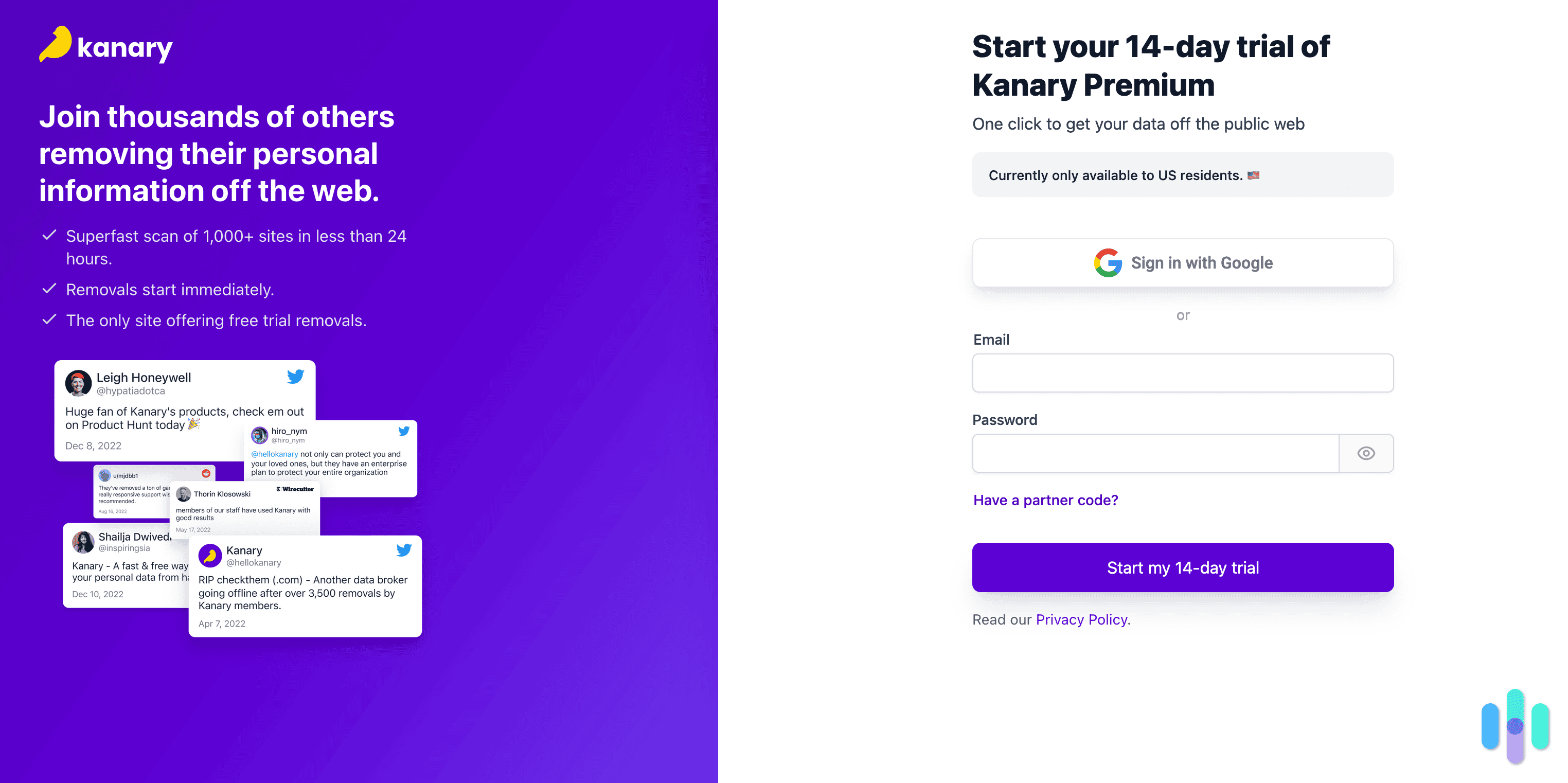
It’s worth flagging upfront that unlike Kanary (another data removal service I recently reviewed), Incogni doesn’t offer a free trial. Every plan comes with a 30-day money-back guarantee instead, so there’s still a way to test the service without much risk, but it still requires that you spend money on the service first. They will refund you if you find the service unsatisfactory, as long as you cancel within 30 days.
Now as for the actual prices, you have two options to choose from — Standard and Unlimited. The biggest difference is that Unlimited gives you custom removals, which means if you find your personal information in a website or data broker not originally covered by the Standard plan, you can submit it to Incogni and request a custom removal. Standard covers 420+ data brokers, but Incogni claims they’ve removed data from over 3,000 sites and data brokers through custom removals.
Aside from the base Standard and Unlimited plans, there are also family plans that expand the protection to up to five users.
Here’s the complete breakdown:
| Incogni Pricing | Standard | Unlimited | Family | Family Unlimited |
|---|---|---|---|---|
| Monthly Plan | $15.98 | $29.98 | $31.98 | $45.98 |
| Annual Plan | $95.88 (avg. $7.99/mo) | $179.88 (avg. $14.99/mo) | $191.88 (avg. $15.99/mo) | $275.88 (avg. $22.99/mo) |
| Savings (annual vs. monthly) | 50% | 50% | 50% | 50% |
| Number of users | 1 | 1 | 5 | 5 |
You’ll notice there are monthly and annual plans. I’d like to point out that data removal isn’t a one-and-done ordeal. Legally, most data brokers have between 30 to 45 days to comply with opt-out requests. Opting out once also doesn’t mean your data will never appear in their databases again. It’s kind of like playing a high-stakes whack-a-mole, so I recommend signing up for a long-term subscription (yearly). As an added bonus, signing up for the annual plan gives you 50 percent off compared to the monthly plan.
Untangling Data Removal Coverage: Coverage claims vary across the industry. For instance, DeleteMe claims coverage at 750 websites. Digging deeper, I found that it only automatically removes data from over a hundred sites. The rest are custom removals. I appreciate Incogni’s honest coverage breakdown here — 420+ data brokers for automated removals, 3,000+ sites handled through custom removals on the Unlimited plan. That puts them at a combined 3,420+ sites total.
Setting Up Incogni
After purchasing my Incogni subscription, I received a verification email. Through the email link, I completed my account and verified my profile. It’s also where I added my personal information, which Incogni eventually used to confirm if my records are in data broker services it covers.
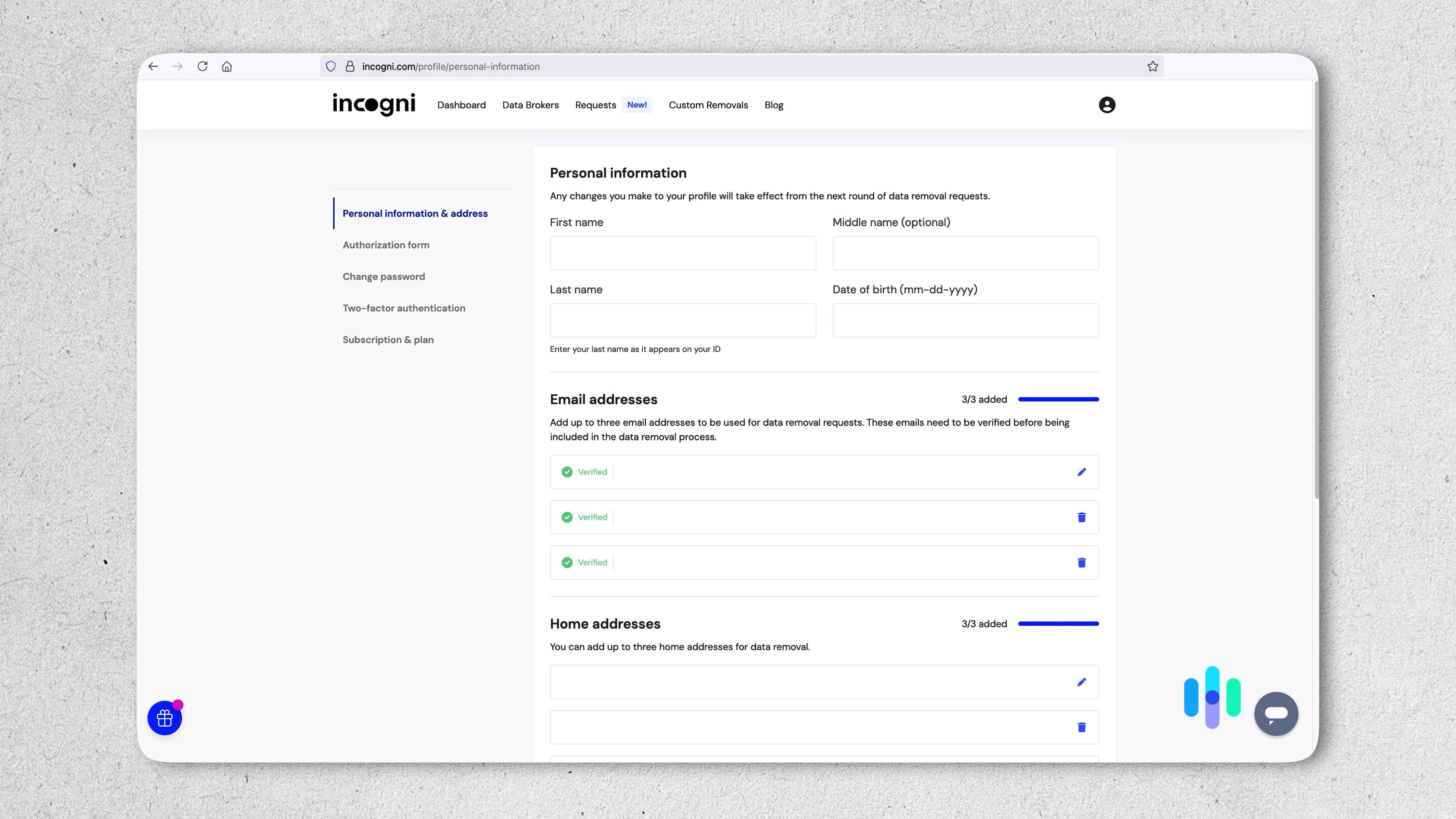
The personal information Incogni requested included:
- Full name
- Address
- City
- State
- Zip Code
- Country
- Email (up to three)
- Phone Number
- Date of Birth
I recommend completing all available fields. Data removal services are much more thorough and accurate if they have all your necessary information. Completing your profile also helps speed up the data removal process.
Expert Tip: You can add up to three emails and physical addresses in Incogni. I recommend completing all available fields for the most thorough removal process possible.
>> Keep Reading: How to Remove Your Name From the Internet
Next, you’re asked to sign an authorization form that essentially allows Incogni to act as a proxy to delete your data for you. Here’s a look at the fine print:
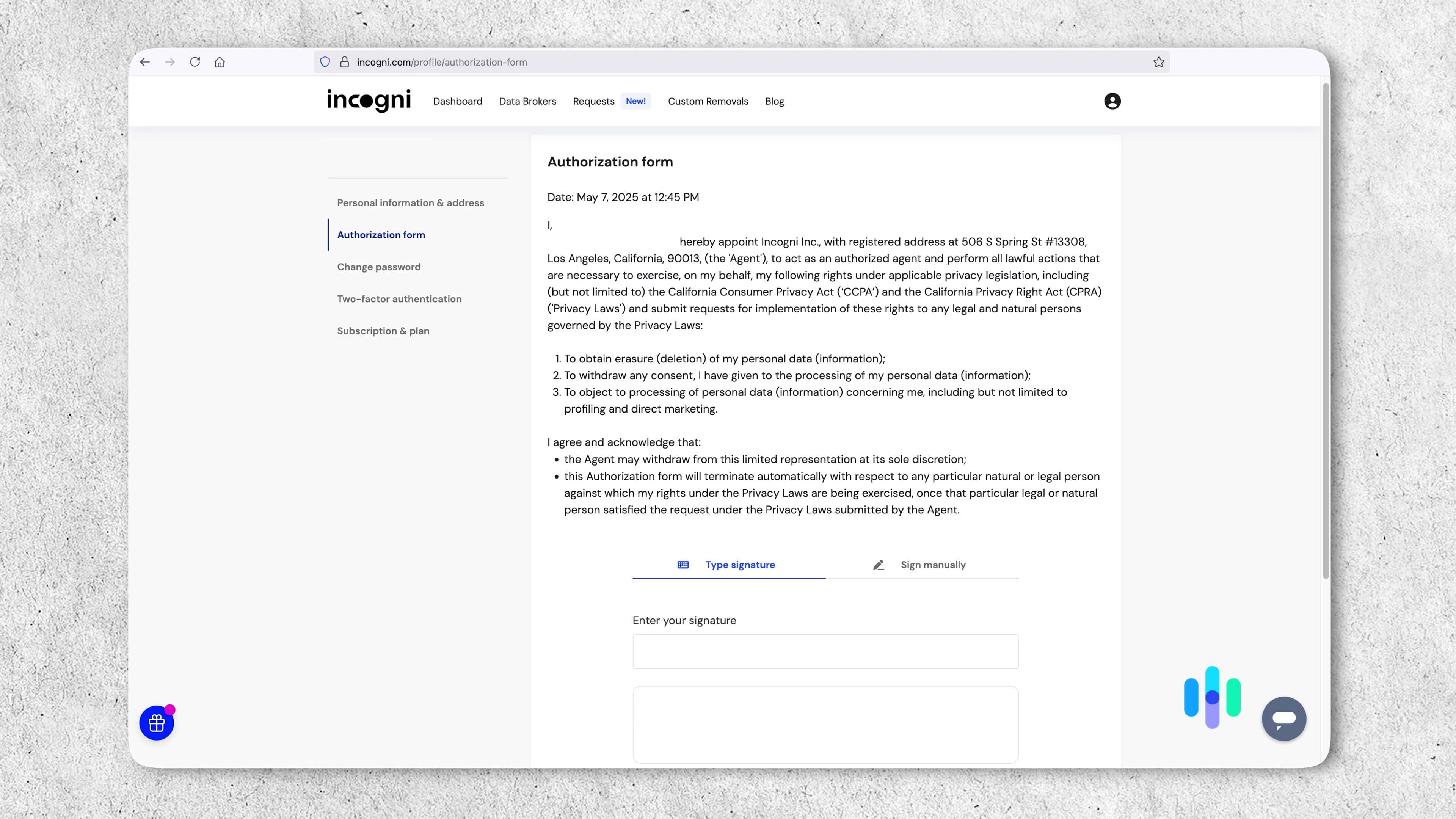
After completing my profile, Incogni asked me to sign an authorization form, which is a legal document essentially allowing the service to act as a proxy to opt you out of data broker databases. The form looks very judicial — and it is — but it helps compel data brokers to honor opt-out requests made by Incogni on your behalf. It also gives Incogni the power to act against non-compliant data brokers.
I thoroughly read the authorization form and didn’t see anything that raises any red flags, so I signed it. After that came the exciting part — the “Start Data Removal” button that kickstarted the whole process.
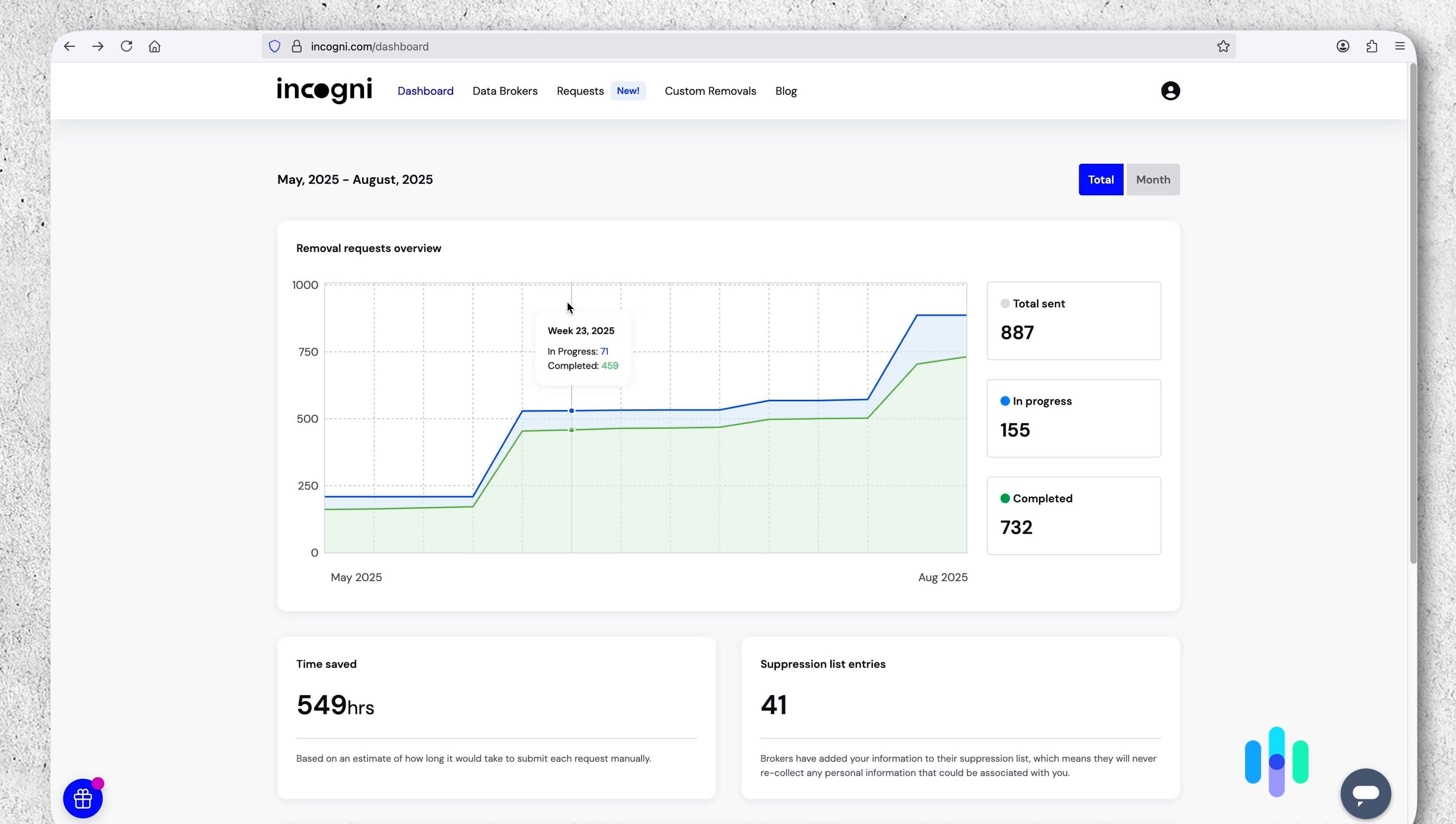
I clicked the button and Incogni started its search. It didn’t actually show me where it was searching, but it led me to a dashboard that gave me an overview of what it’s done so far. The dashboard (see above) is pretty simple, but it’s also efficient, in my opinion. As you can see, it found 79 files/records with my personal information right off the bat. It’s not a huge number, especially with Incogni’s “420+ data brokers covered” claim, but keep in mind, that screenshot was taken just a few minutes after I clicked “Start Data Removal.” The number only increased from there, as you’ll see after this section. But before we talk about numbers and stats, allow me to direct you to one of the more useful parts of the dashboard: the “detailed view.”
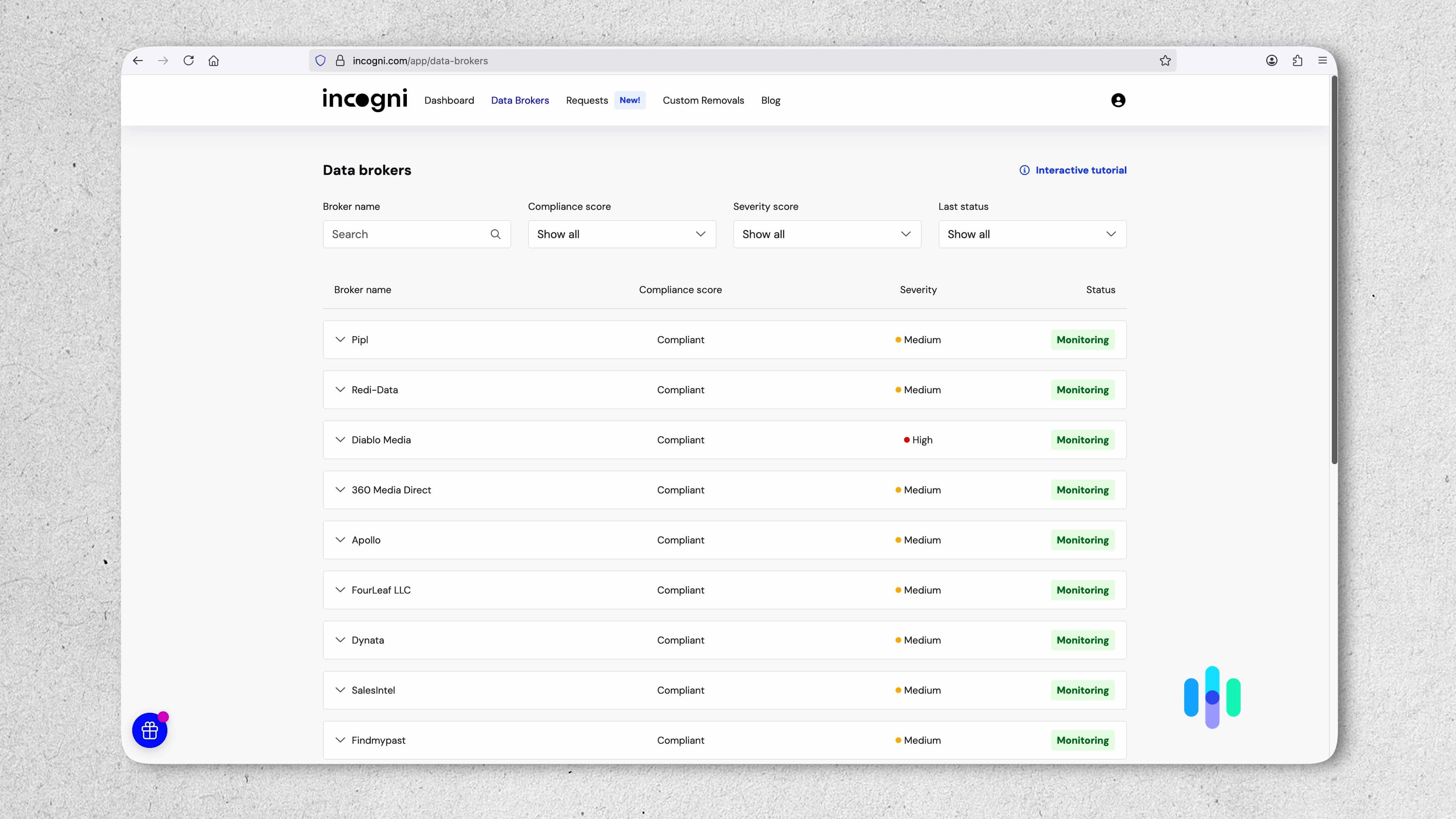
As opposed to the “overview” dashboard, the “detailed view” section gave me a better idea of what Incogni was doing in the background. For example, under the “Requests” tab, I could see which companies Incogni had sent removal requests to, including both past and ongoing removals.
I also found the “data brokers” section interesting, as it gives you an idea which data brokers are being monitored, the “severity” of the personal information they collect, and how compliant they are to opt-out requests. In the screenshot above, you’ll see one “high-severity” data broker, and even though they are compliant, that part of the dashboard tells me to keep an eye out for my personal information popping up in their databases.
Another thing I like about this part of the dashboard? You can click on a specific data broker and see more details about them (see screenshot below).
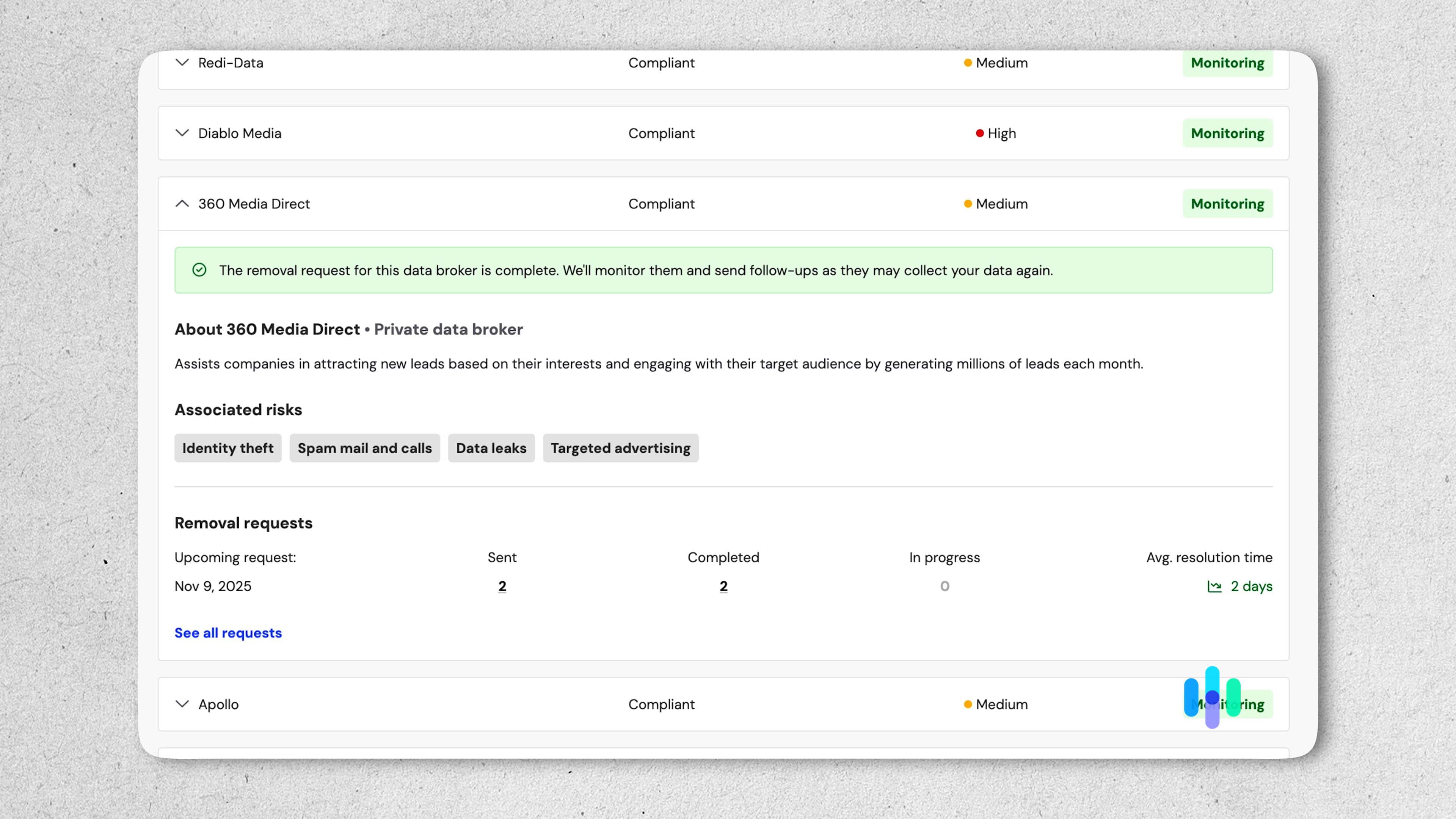
Now this is really interesting information. You can see the average time it takes for a resolution to take effect, you can view your request history, you can learn more about the database itself, and you can see all of the associated risks that come with having your information show up there. This is by far the most detailed reporting I’ve seen with one of these services, and I was really impressed with how granular Incogni is able to get here.
So far so good, but as I mentioned above, these services take some time to do their thing. I decided to check back in a week and see what progress had been made.
Did You Know: When I reviewed DeleteMe, I saw it claims to check over 750 websites. After digging deeper, I learned that it only covers 100+ data broker sites, and the rest make up custom requests. Incogni offers unlimited custom removal requests, covering significantly more than 1400 websites.
Ready to See Your Own Results?

Remove Your Data
Links to Incogni
Incogni at One Week
I popped back into my Incogni dashboard after a week to check on its progress, and it was pretty impressive. It had submitted a total of 225 removal requests — 66 had been completed, and 159 were in progress. In addition, Incogni had 17 brokers add my information to their suppression list, which means those organizations would not create new profiles on me in the future. That’s a nice addition to the service that really improves your long-term success in scrubbing the internet of your personal information.
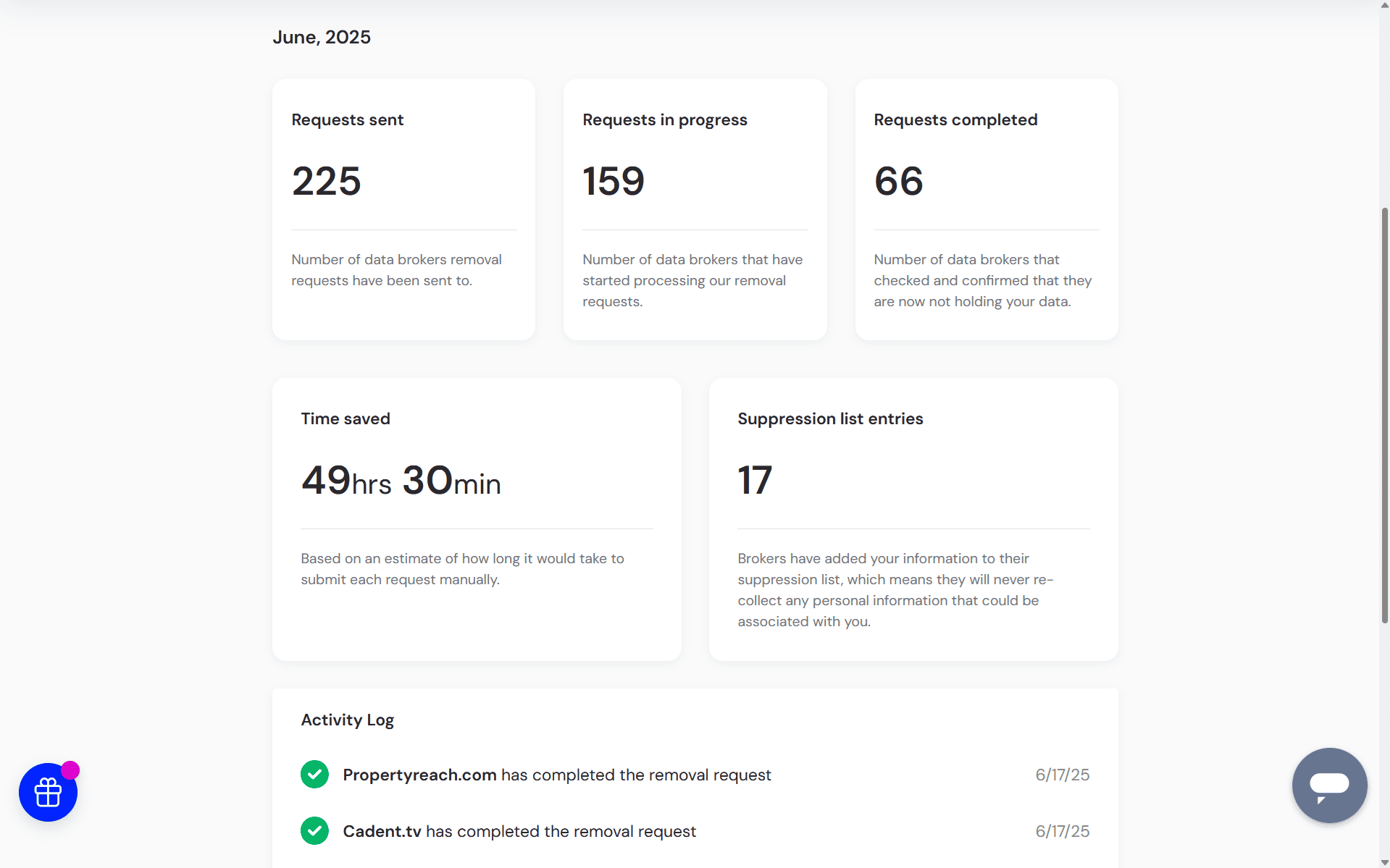
I couldn’t help but compare Incogni to other data removal services I’ve tested. At one week, Kanary had only removed three profiles, and Onered had nabbed just 16. Those are much lower than Incogni’s stats. The caveat is that Incogni defines “requests” a little differently than those services. When you first start up the service, it sends out a bunch of automated emails to its list of 420+ data brokers. If it hears back from them — even if the response just states they don’t have a file on you — Incogni counts those as completed. In short, “completed” doesn’t necessarily mean “we found your data in their database and had them remove it.” It could also mean that Incogni checked if those data brokers have your personal information and found that they don’t. It’s still good news, but it’s a reality worth pointing out.
>> Learn More: Five Ways to Opt-Out of Personal Data Collection
While it seems a little less-than-transparent, it’s still clear that Incogni is extremely effective at what it does. Given how quickly it worked in just seven days, I’m excited to see the progress after two weeks.
Incogni at Two Weeks
I decided to give Incogni another week to see how far it will take data removal, and the “completed requests” jumped from 66 to 101. That’s a slight slowdown after the initial push, but I still find it impressive. That means my personal information is already scrubbed from 101 of the 420+ data brokers in Incogni’s crosshairs. That’s not nothing.
In addition, it’s worth circling back to one of the legal caveats of data removal — data brokers have 30 to 45 days to comply. No matter which service you go with, data removal rate is affected by how quickly data brokers process and comply with requests. What’s most important is that you see your data removal service doing its job of searching databases for your personal information and automatically submitting removal requests, and that’s one area where Incogni really showed up.
Still, what I said in week one stands. Legally speaking, many of these data brokers and people-finder sites have up to 45 days to respond to removal requests. No matter which service you go with, you’re going to have to play a bit of a waiting game to see things through to completion.
Despite the slowdown, I’m still impressed with Incogni’s capabilities, though. I would have liked to see a little more progress in week two, but it’s not something I’m going to hold against this service.
Incogni Custom Removals
That covers my two-week experience with Incogni’s standard, automated removals. But that’s only half of what Incogni covers. The Unlimited plan opens up Custom Removals, which you can use to submit custom removal requests for websites and data brokers not originally covered by the Standard plan’s automated removals. I didn’t have any custom removals to make during my test, but I explored the feature to see how it works.
Let’s say you found your personal information sitting on a site that isn’t one of the 420+ brokers Incogni automatically monitors. If you’re on the Unlimited plan, you can paste the URL directly into your Incogni dashboard, and one of Incogni’s privacy specialists takes it from there. They’ll review the link and work the removal by hand. There’s no limit on how many links you can submit, but Incogni works through them three at a time and in the order they came in.
Based on support documentation I found, most custom removal requests resolve within seven to 30 days, with some sites reportedly taking as long as 60 days. You’ll get an email as a request moves from ‘submitted’ to ‘in progress’ to ‘completed’, or ‘rejected’ if the site falls outside what Incogni is able to act on. There are a handful of sites that remain out of reach — for example, social media sites and posts. That said, even though custom removals are slower and require more involvement than automated removals, I think it fills a real gap for anyone whose exposure goes beyond the standard coverage of Incogni.
See how Incogni stacks up against the competition
For a closer look at how Incogni performs, we compared it with other popular brands.
My Overall Impressions of Incogni
Overall, Incogni does what it says it will do, and it does it in a way that’s easy to verify rather than just take on faith. What stood out most over the course of testing wasn’t any single number, it was how consistently the process held up to scrutiny: a dashboard that shows its work instead of just reporting a final tally, a third-party audit standing behind the coverage claims, and a suppression feature that keeps solving the problem after the first pass is done. That’s a different kind of reliability than simply being fast.
It isn’t a perfect service. The lack of a free trial is a real gap, and unlimited custom removals cost more than some people will want to pay. But for a category where it’s easy to overstate what a tool actually does, Incogni’s willingness to have its claims checked by an outside party says more than its removal numbers ever could.
If you aren’t ready to commit to an Incogni plan just yet, you can receive a free scan and report of your personal information found online by filling out the form below:
Would I Recommend Incogni?
I would absolutely recommend Incogni to anyone looking to increase their anonymity online, especially if you’d rather trust a service that’s had its claims checked than take a company’s word for it. It’s a tougher sell if you’re chasing the lowest possible price or want to try before you buy, since there’s no free trial, but the money-back guarantee closes most of that gap for anyone willing to commit for a month. As far as data removal services go, Incogni is among the best.
Incogni FAQs
-
Does Incogni really work?
Yes, our hands-on tests demonstrated that Incogni is effective at removing profiles from data brokers and people-finder sites. They are also able to prevent some sites from creating new profiles on you.
-
Are data brokers legal?
Unfortunately, yes. Data brokers and people-finder sites compile personal information about you that is available through other sources in one place. What they are doing isn’t illegal, but it can be viewed as an invasion of privacy.
-
Will Incogni delete social media posts?
No, Incongi does not have the ability to remove posts about you on social media platforms. If you are being harassed or bullied, you should reach out to the platform’s privacy team.
-
Will Incogni prevent people from seeing my police record?
No, Incogni cannot hide public records. In order to prevent people from finding this type of information, you’ll need to legally expunge your record.
-
How can I remove a news story about me?
There is no automated way to remove a story that mentions your name from a news site. If you’re concerned about your privacy you can reach out to the site’s editorial team, or, if you feel like you’re the victim of libel, you can contact a lawyer.