

VPN Use in 2026: Trends, Statistics, and Consumer Sentiment
 Last Updated on Sep 16, 2026
Key insights
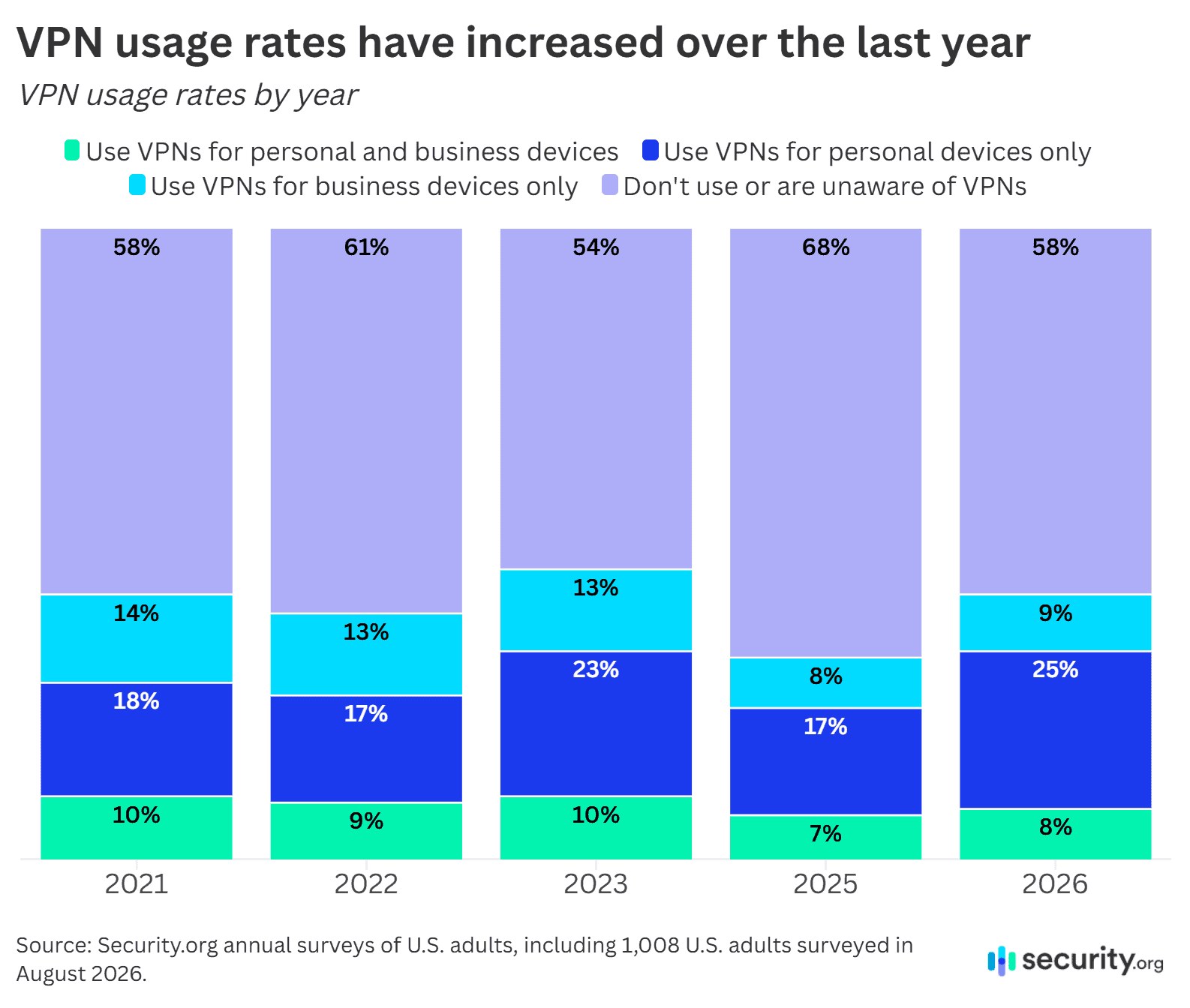
- 42 percent of U.S. adults use a VPN for personal or work purposes, up from 32 percent in 2025. Men and adults aged 18 to 29 had the highest adoption rates.
- General privacy (56 percent) and general security (51 percent) remained the most common reasons for using a VPN. Access to international or non-local media and reducing online tracking tied for third at 27 percent each.
- More than 1 in 10 VPN users rely on VPNs for accessing age-restricted or adult content.
- NordVPN remained the most-used brand, rising from 17 percent of users in 2025 to 24 percent in 2026. Proton VPN ranked second at 15 percent.
- Free VPN use rebounded from 28 percent of users in 2025 to 43 percent in 2026. Among users who paid, the average reported cost was $21 per month.
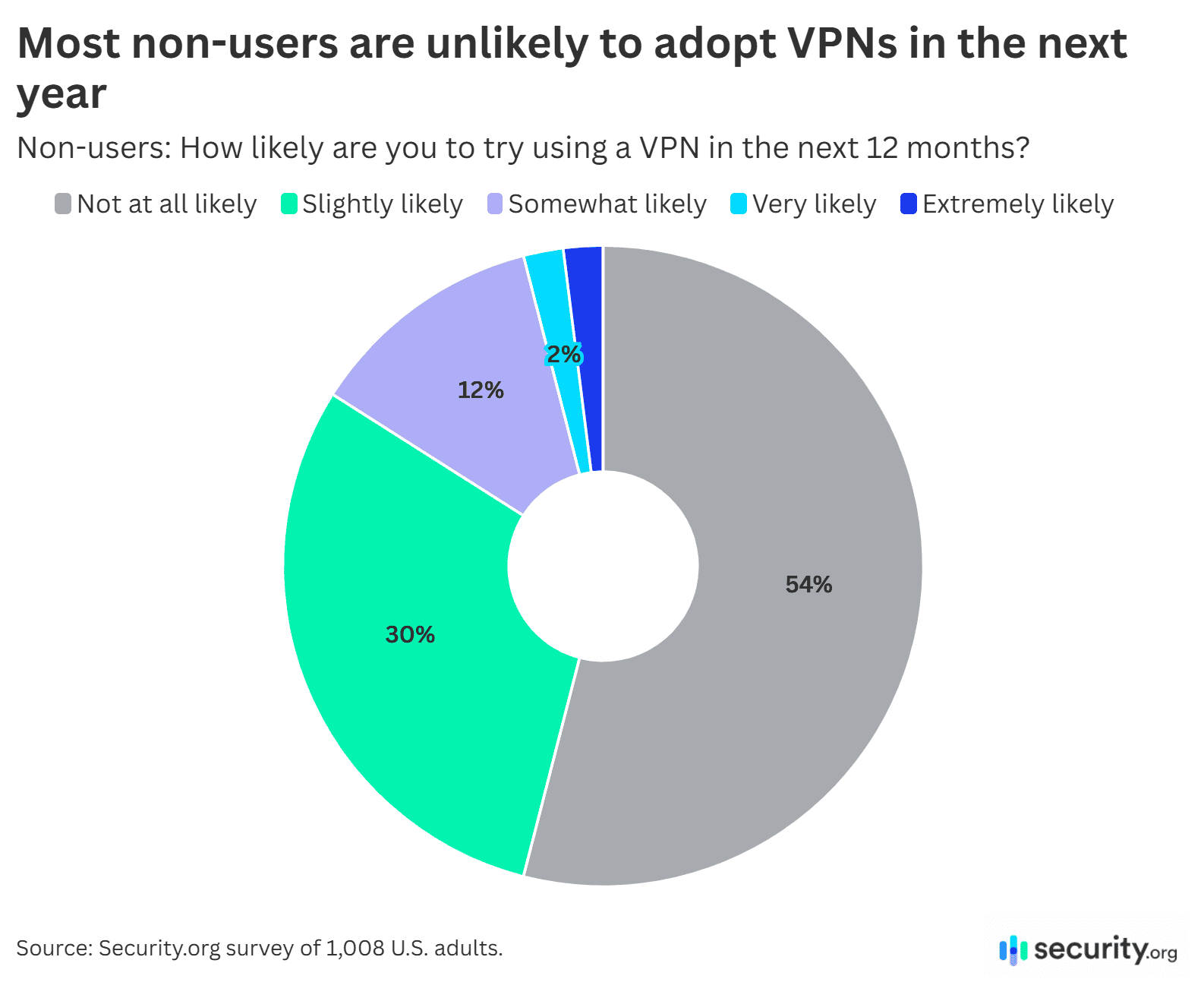
- 16 percent of people without VPNs said they are at least somewhat likely to adopt the technology in the next year.
VPNs have moved beyond cybersecurity software into the center of a national debate over online privacy and identity. After the U.S. Supreme Court upheld a Texas age-verification law for adult websites in June 2025, states began targeting the VPN workaround directly. The most notable state was Utah, which ruled in 2026 that residents remain subject to its age-verification law even when a VPN masks their location. They also barred adult sites from promoting VPNs as a bypass.
The FBI reported nearly $20.9 billion in internet-crime losses in 2025, a 26 percent jump from the year before, which helps explain why more consumers are turning to online privacy tools. But VPNs have limits: they encrypt traffic and hide IP addresses, but can’t stop most scams or replace antivirus protection.
For our fifth annual VPN report since 2021, Security.org surveyed 1,008 Americans to understand how they use VPNs, what they expect from the technology, and how the current legal and security landscape is shaping adoption.
VPN Usage in 2026
A VPN, or virtual private network, is a type of software that changes how your device connects to the internet. It sends all traffic through an encrypted tunnel to a VPN server, protecting your online data and activity from both bad actors and your internet service provider. It also hides your real IP address from the websites you visit.
Given their wide-ranging privacy benefits, VPN use rose substantially in 2026. Forty-two percent of Americans said they used a VPN on personal devices, business devices, or both, compared with 32 percent in 2025. Personal-only use drove much of the increase, rising eight percentage points to 25 percent. Business-only and mixed personal/business use changed little.
VPN user demographics
Our survey showed that certain demographic groups were more likely to currently use VPNs. Men were more likely than women to use VPNs, especially for personal purposes. Overall, 60 percent of women did not use a VPN, compared with 50 percent of men. Twenty-nine percent of men used one only for personal purposes, versus 20 percent of women, and 11 percent used one for both personal and business purposes, compared with five percent of women.
We found that VPN use rates generally declined with age. Fifty-one percent of adults ages 18 to 29 used a VPN, the highest rate of any age group, while nearly two-thirds of adults 60 and older did not use one. Personal-only use was especially concentrated among younger adults: 39 percent of 18- to 29-year-olds used a VPN only for personal reasons, compared with 29 percent of adults ages 30 to 44, 18 percent of those ages 45 to 59, and 15 percent of adults 60 and older.
Top reasons for using VPNs in 2026
In 2026, people are not using VPNs for one single version of “privacy.” Their reasons reflect several pressures shaping the modern internet: commercial tracking, location-based laws and content restrictions, remote access to work systems, and the desire to keep sensitive interests or purchases from becoming part of a visible digital trail.
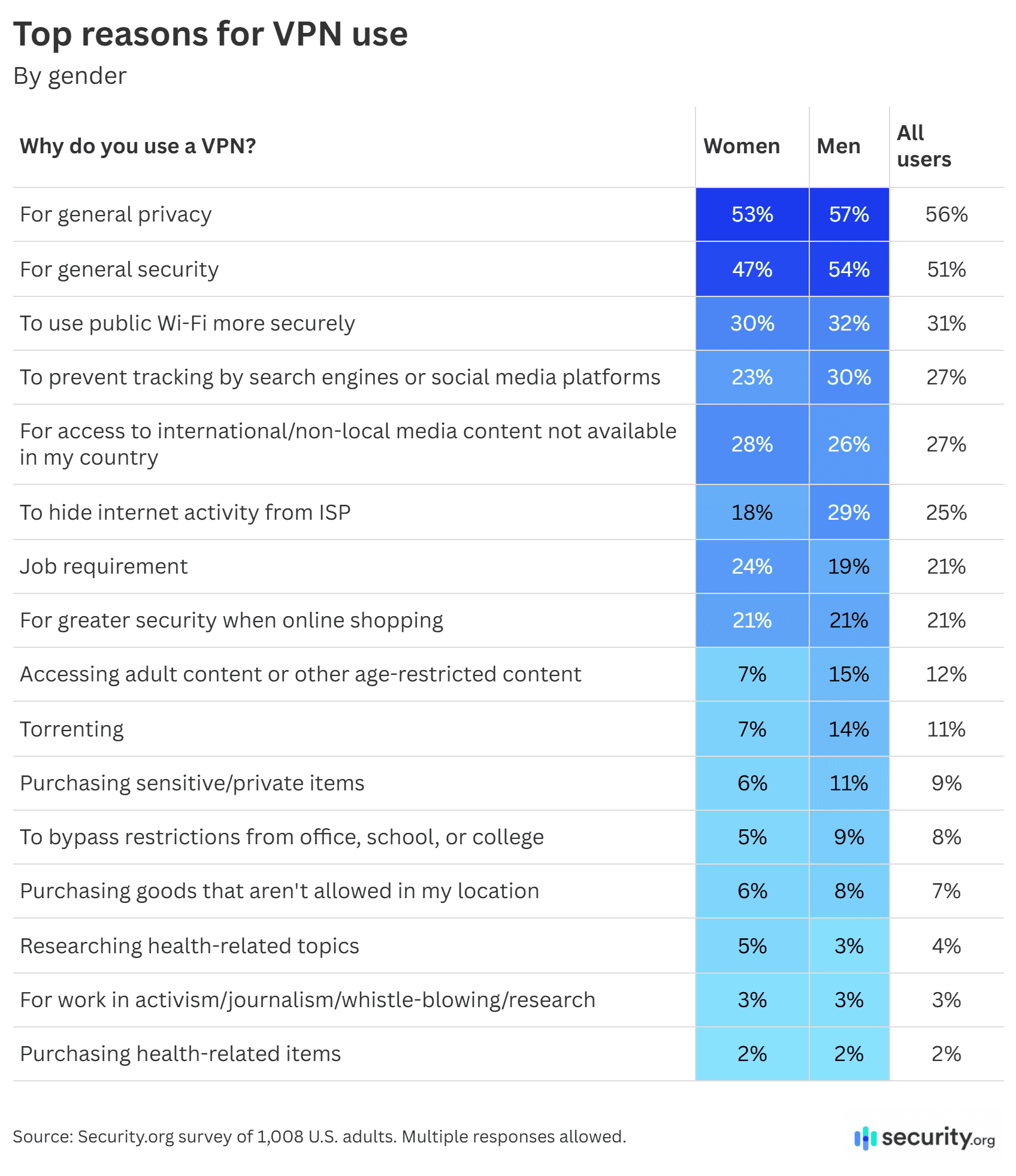
A VPN can hide browsing destinations from an ISP or local network, which explains why 25 percent of users cite hiding activity from their ISP as a reason for using one. But a VPN cannot stop tracking tied to accounts, cookies, apps, or advertising IDs — the kind of tracking 27 of users say they’re trying to avoid from search engines and social platforms. Likewise, while the FTC notes that website encryption has made public Wi-Fi safer than it once was, a VPN adds a layer of protection on public networks without preventing phishing or fraud.
Location masking matters most where laws and access vary by geography. Pornhub and its affiliated sites have blocked access in numerous states amid new age-verification requirements, while interstate disputes have intensified over abortion pills prescribed through telemedicine. For example, in 2025, a New York physician was fined in Texas and charged in Louisiana over allegations she mailed abortion medication to patients there. These developments help explain why some users turn to a VPN to access age-restricted content, purchase controversial medications or goods, or research health topics.
Reasons for VPN use also vary by demographic. Men were twice as likely as women to cite torrenting and were also more likely to use VPNs to hide their activity from ISPs or to access age-restricted content. Compared with users ages 45–59, those ages 18–29 were more likely to cite international media access (36 percent vs. 23 percent), torrenting (14 percent vs. six percent), and bypassing school or workplace restrictions (18 percent vs. four percent).
Top VPN brands
Among all VPN brands, NordVPN strengthened its lead in 2026, climbing seven percentage points to 24 percent of users. Proton VPN also gained ground, rising from nine percent to 15 percent. Norton VPN and the newly listed Cisco Secure Client VPN tied for third at nine percent, followed by ExpressVPN at seven percent.
Over the last several years, the market has remained fragmented. Several browser-based or built-in products appeared in the 2026 results, including Firefox built-in VPN and Opera Free VPN. Meanwhile, the share attributed to other brands declined from 31 percent in 2023 to 11 percent in 2026, suggesting that use has become more concentrated among named providers.
| What VPN brand(s) do you currently use? | 2023 | 2025 | 2026 |
|---|---|---|---|
| NordVPN | 27% | 17% | 24% |
| Proton VPN | 13% | 9% | 15% |
| Norton VPN | 6% | 8% | 9% |
| Cisco Secure Client VPN | – | – | 9% |
| ExpressVPN | 8% | 9% | 7% |
| Surfshark | 5% | 4% | 6% |
| Windscribe | 3% | 6% | 5% |
| Firefox built-in VPN | – | – | 5% |
| Opera Free VPN | – | – | 4% |
| Private Internet Access | 7% | 6% | 4% |
| Brave VPN | 7% | 3% | 4% |
| Mullvad | 4% | 2% | 3% |
| VPN by Google | 9% | 5% | 3% |
| Mozilla VPN | 5% | 2% | 3% |
| Other VPNs | 31% | 15% | 11% |
Source: Security.org survey of 1,008 U.S. adults. Multiple responses allowed.
Several developments may have influenced the changes in recent years, although our survey did not explore why users chose their particular VPN brand: Proton expanded its free server network and reported a 520 percent increase in U.S. signups during TikTok’s brief 2025 shutdown. Atlas VPN closed and transferred its paid users to NordVPN in 2024, and Nord later introduced NordWhisper for networks that detect or block standard VPN traffic. Google’s longer-term decline followed the shutdown of VPN by Google One, although the VPN service remained available on certain Pixel phones and through Google Fi.
Additional VPN features
VPNs encrypt traffic between a device and a VPN server, hide browsing destinations from an internet service provider, improve protection on unsecured public Wi-Fi, and make a device appear to connect from another location. They do not provide total anonymity, stop every form of tracking, or replace antivirus software. That last point is also the most common misconception: 36 percent of respondents incorrectly believed a VPN alone can protect a device from viruses or malware.
Because VPNs cannot fully protect devices from malware and other threats, some providers offer bundles with antivirus or other protective software. NordVPN and Surfshark both pair their VPNs with antivirus protection and dark web monitoring, while NordVPN’s higher tiers also add a password manager, called NordPass. Our survey found that most users either lack access to additional digital security services through their VPN or choose not to use them.
| Do you use any of the following additional features of your VPN (if offered)? | Percent of users |
|---|---|
| Antivirus | 15% |
| Password manager | 14% |
| Secure file sharing | 8% |
| Dark web identity monitoring | 6% |
| Tor over VPN | 1% |
| None of the above | 56% |
Source: Security.org survey of 1,008 U.S. adults. Multiple responses allowed.
Free VPNs
For many Americans, the appeal of free VPNs comes down to simple economics and convenience. Free VPN options offer an easy, no-commitment entry point for users who want basic privacy protection or need to bypass a one-time content restriction without spending money.
| Year | Percent of users with a free VPN |
|---|---|
| 2023 | 43% |
| 2025 | 28% |
| 2026 | 43% |
Source: Security.org annual surveys of VPN users.
Forty-three percent of VPN users relied on a free service in 2026, up from 28 percent in 2025. Among those who paid for their VPN access, the average reported cost was $21 per month.
Payment was associated with more intensive and specialized use, but not with fewer reported problems. Both free and paid users reported slow speeds, streaming difficulties, disconnections, advertisements, bugs, or privacy concerns at similar rates.
Barriers to VPN Adoption
The largest barrier to VPN adoption was not price or technical difficulty, but perceived necessity: 39 percent of non-users simply said they did not need a VPN. Nearly one-quarter said they did not know enough about VPNs, while about one in five did not see the benefit or considered the products too expensive.
| Why don’t you use a VPN? | Percent of non-users |
|---|---|
| I don’t need one | 39% |
| I don’t see the benefit | 19% |
| I don’t know enough about them | 24% |
| Too expensive | 18% |
| Sites block them | 12% |
| Too much trouble to set up | 13% |
| I don’t trust their privacy | 4% |
| I don’t trust their security | 5% |
Source: Security.org survey of 1,008 U.S. adults. Multiple responses allowed.
Barriers also differed by demographic group. Women were more likely than men to say they did not know enough about VPNs, and men were more likely to cite cost as a barrier. The youngest adults in the study were the most likely to say VPNs were too expensive and too difficult to set up. The fact that younger adults can be highly familiar with VPNs yet still reject them over price and setup is important. Education alone will not close every adoption gap; products also need to feel affordable and easy to use.
Market Outlook
VPN adoption recovered in 2026, but future growth is far from guaranteed. More than half of non-users were not likely to try a VPN in the next 12 months. Sixteen percent were at least somewhat likely, creating a modest group of potential new users.
The market’s next phase is likely to depend on three issues: demonstrating a clear everyday benefit, reducing friction, and earning trust. Privacy and security remain compelling, but many non-users still do not think they need a VPN. Younger non-users are sensitive to price and setup, while free products are again attracting a large share of users. Providers may need to make paid plans more affordable or more clearly differentiated from free options.
Trust will matter just as much. Sixty-two percent of respondents said it was very or extremely important for their VPN to keep no activity logs. However, many incorrectly assume VPN providers cannot see their browsing destinations. Clear explanations of data collection, independent audits, and the limits of VPN protection could help consumers choose services more responsibly.
VPNs are no longer niche, but they are not universally understood or valued. In 2026, adoption rebounded even as skepticism and practical barriers grew. The providers that can translate technical privacy promises into simple, credible, everyday value will be best positioned to turn awareness into lasting use.
Our Data
The 2026 VPN Annual Report is based on an online survey of 1,008 U.S. adults conducted in August 2026. The study examined consumer adoption, use, and perceptions of virtual private networks. It was designed as a national consumer study and to support analysis of year-over-year trends in VPN adoption and behavior dating back to 2021.
Participants were recruited through a reputable online research platform to obtain a diverse sample of U.S. adults. The study was structured so the final sample represented the U.S. population by sex, age, and race, based on benchmarks from the 2020 U.S. Census. Participation was limited to adults living in the United States. Only completed surveys from eligible respondents were included in the final analytical sample.
No weighting was applied to the survey responses. The results, therefore, reflect the responses of the final sample directly rather than estimates adjusted through post-stratification or another weighting procedure.
For questions answered by the full sample of 1,008 respondents, the maximum margin of error is approximately ±3.1 percentage points at the 95 percent confidence level. This estimate assumes a population proportion of 50 percent, which produces the most conservative estimate of sampling error. Margins of error are larger for questions answered by smaller subgroups, such as VPN users or non-users.
The online platform used to collect responses does not allow users to access it through a VPN. This restriction may have led to underreporting of VPN use. As with all self-reported research, the findings may also be affected by respondents’ recall and understanding of VPN technology.