

VPN Unlimited Review 2026: Solid for Local Connections, Struggles at Distance
VPN Unlimited's nearby server speeds barely dipped from our baseline, but without an independent no-logs audit, privacy-focused users have real reasons to look elsewhere.
 &
&
 Last Updated on Jun 14, 2026

What We Like
- Strong nearby speeds: On our nearby server connection, VPN Unlimited barely moved the needle: 168.73 Mbps down versus our 178.01 Mbps unprotected baseline.
- Dedicated streaming servers: VPN Unlimited labels individual servers for Netflix, Disney+, Amazon Prime Video, BBC iPlayer, Hulu, Max, and more. The server list makes it easy to find the right option without guessing.
- Responsive customer support: Our live chat query was answered in under three minutes, and the support interface opens directly in the app.
What We Don't Like
- No independent no-logs audit: VPN Unlimited claims a zero-logs policy but has not submitted to an independent third-party audit to verify it.
- Severe long-distance speed drops: Our distant server test returned just 20.76 Mbps down on a 178 Mbps baseline connection, an 88% reduction.
- Inconsistent streaming performance: Despite dedicated streaming servers, results varied widely across platforms.
Bottom Line
the security.brief
We tested VPN Unlimited on speed, streaming, and security across macOS and Android. See how it performs, what it costs, and who it's actually built for.
VPN Unlimited is developed by KeepSolid, a New York-based software company that has been building privacy and security tools since 2013. VPN Unlimited has grown to 3,000+ servers across 80+ locations and supports an unusually wide range of protocols, including its own proprietary KeepSolid Wise, which doubles as an obfuscation tool. It’s a capable product in many respects, particularly for users based near supported server locations.
After weeks of testing, we found it to be a capable VPN, but two things hold it back from the top tier. First is its US jurisdiction with no independent audit to back its no-logs claims. Second is the speed performance that falls apart over long distances. We tested it across Windows, macOS, iOS, and Android. Here’s how it stacks up against the best VPNs on the market.
Did You Know: The global VPN market is projected to reach $151.92 billion by 2030, growing at a 17.7% annual rate driven by rising cybersecurity threats and unsecured public Wi-Fi use,1 and North America already accounts for more than 53% of global VPN market share,2 figures that reflect just how mainstream privacy tools have become, and how much is at stake when a provider’s no-logs policy goes unverified.
What We Tested
We ran VPN Unlimited through our standard VPN testing cycle, covering the following areas:
- Speed tests: We ran tests per server location using our documented speed testing process against a 178 Mbps baseline connection using WireGuard.
- DNS leak tests: We tested across four server locations and verified no DNS requests escaped the VPN tunnel.
- Kill switch: We evaluated the kill switch behavior, settings location, and platform-specific limitations.
- Streaming access: We tested Netflix US, Disney+, BBC iPlayer, and Amazon Prime Video using both dedicated streaming servers and standard servers.
- App usability: We evaluated setup, navigation, and feature access across macOS and Android.
Expert Note: VPN Unlimited’s dedicated streaming server list is one of the more organized we’ve seen. On both macOS and Android, the app categorizes streaming servers by platform name (Netflix, Disney+, Amazon Prime Video, BBC iPlayer, Hulu, Max), making it immediately clear which server to use for which service, and that’s a meaningful usability improvement over VPNs that make you search by country and hope for the best.
Speed and Performance
VPN Unlimited’s speed story is split cleanly in two. Our experience with the nearby servers was impressive, with average speed drops of around 5 percent. This kind of performance can go toe-to-toe with even the fastest VPNs we’ve tested. In our NordVPN tests, for instance, the average speed drop across nearby and distant servers was also around 5 percent.
The other side of VPN Unlimited’s speed story, however, is its slow performance on long-distance connections. Long-distance performance is among the weakest in our test series.
Here’s the complete results.
| Server Location | Avg. Download Speed | Avg. Upload Speed | Speed Reduction |
|---|---|---|---|
| Baseline (no VPN) | 178 Mbps | 46 Mbps | — |
| Nearby (nearest US server) | 168 Mbps | 44 Mbps | ~5% |
| Mid-distance (< 4,000 miles) | 147 Mbps | 43 Mbps | ~17% |
| Long-distance (> 10,000 miles) | 20 Mbps | 9 Mbps | ~88% |
The nearby and mid-range results are strong. The nearby servers we tested produced imperceptible speed losses, and the mid-distance server held up well with an average speed loss of about 17 percent. Those are competitive numbers for everyday use, HD streaming, and video calls. The distant server result is the outlier. An 88 percent reduction to around 20 Mbps is not a typical long-distance result. It points to a specific routing or server load issue rather than general VPN overhead.
Our recommendation? If speed is a priority, it’s worth noting and worth testing VPN Unlimited yourself by connecting to your most-used server locations before committing to a plan.
Testing Note: All tests were run using WireGuard on a 178 Mbps baseline connection. We tested each server multiple times and they consistently produced similar figures.
Privacy and Security
VPN Unlimited is developed by KeepSolid, Inc., headquartered in New York. That places it firmly under US jurisdiction and within the Five Eyes intelligence-sharing alliance. Canadian law and US law both allow government agencies to compel service providers to hand over data under legal process, and neither requires providers to notify users when this happens.
The good news is that KeepSolid claims a zero-logs policy, stating that it does not store browsing history, connection timestamps, or traffic data. However, the privacy policy does disclose that certain session-level data (including IP address, browser type, and operating system) may be stored temporarily during an active VPN session and deleted afterward. The company states this data is never connected to personally identifiable information.
We see other top-tier VPNs store the same session-level data — see our Surfshark review for example. That’s standard practice in the industry and is acceptable as long as the practice is verifiable. In Surfshark’s case, they’ve had several security auditors come in and review their policies independently. VPN Unlimited, however, is still yet to submit its privacy policy to a third-party audit. For a VPN provider based in the US with Five Eyes exposure, we think the absence of an audit is a gap that needs to be addressed.
>> Learn More: The Best No-Logs VPNs
Privacy Note: A 2021 KPMG survey found that 40% of consumers do not trust companies to ethically use their data, and 30% say they’re unwilling to share personal data for any reason.3 VPN Unlimited’s unverified no-logs policy and US jurisdiction sit squarely in that concern. Users for whom privacy is the primary reason for using a VPN should consider an independently audited alternative such as Proton VPN, which has completed four independent no-logs audits.
Leak Tests, Protocols, and Encryption
Besides evaluating VPN Unlimited’s privacy policy, we also tested privacy- and security-specific features. Mainly, we tested for DNS leaks and WebRTC leaks, and verified that the kill switch is working. We also checked what kinds of VPN protocols and encryption standards the VPN uses, since those have major impact on a VPN’s privacy and security.
For our practical tests (DNS leak, WebRTC leak, and kill switch verification), VPN Unlimited performed as expected. Across four server locations, we found no DNS and WebRTC leaks. The kill switch also immediately cut traffic when the VPN was interrupted.
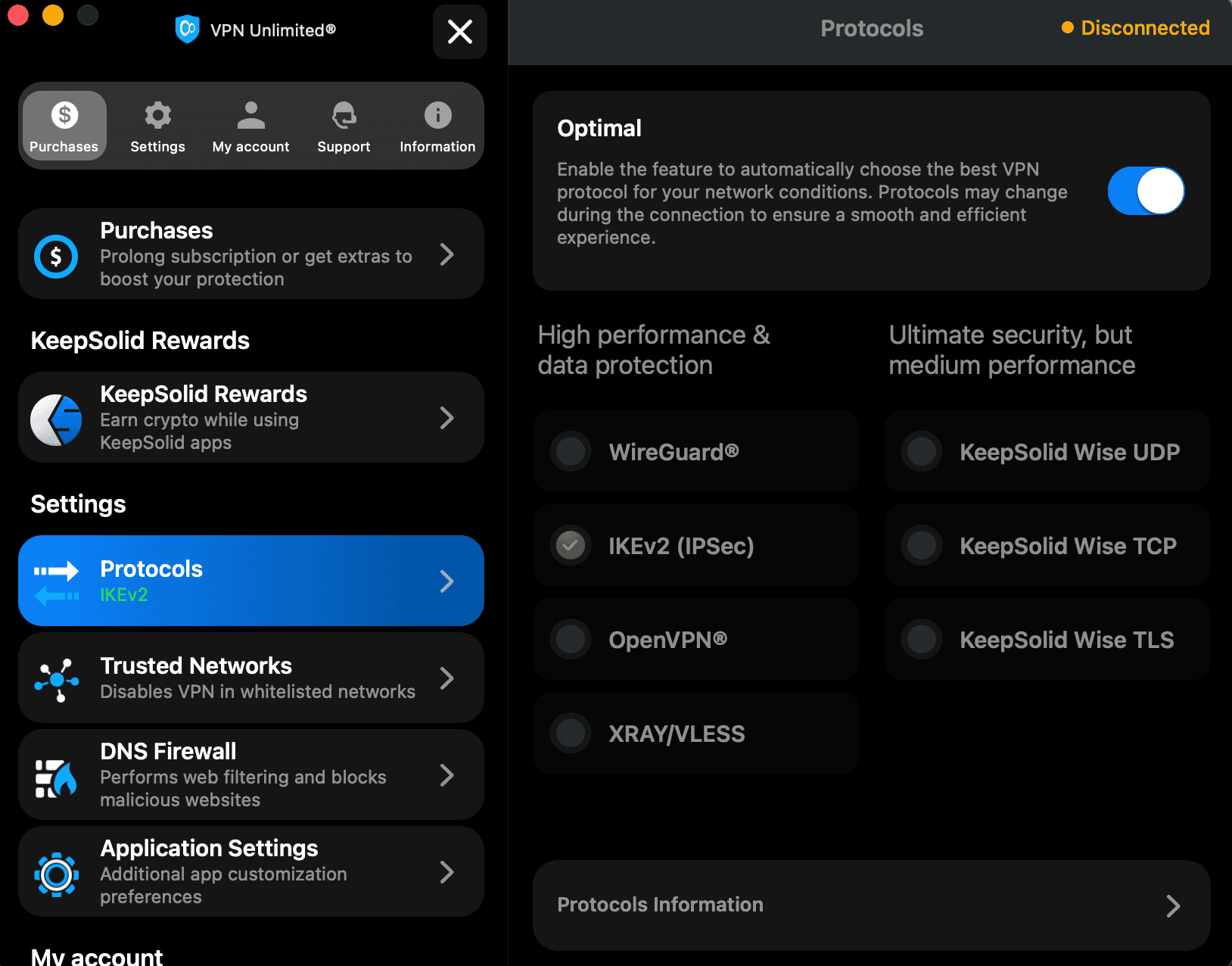
On the protocol side, VPN Unlimited supports a surprisingly wide variety of options, but most notable WireGuard, OpenVPN, and KeepSolid Wise. We generally recommend WireGuard for its balanced speed and security, but for users who need stronger encryption and/or obfuscation, OpenVPN and KeepSolid Wise work well. KeepSolid Wise is a proprietary protocol with built-in obfuscation, making it efficient in hiding VPN traffic from networks and countries where VPN use is restricted.
Features
VPN Unlimited’s feature set is broader than most mid-tier VPNs. Here are some of the features we tested that are worth noting:
- Dedicated streaming servers: Unlimited VPN has labeled servers for Netflix, Disney+, Amazon Prime Video, BBC iPlayer, Hulu, Max, and other major platforms. It has more platform coverage than most VPNs we tested with dedicated streaming servers, but we found that performance varies across platforms.
- KeepSolid Wise: This is a proprietary VPN protocol with built-in obfuscation. It routes VPN traffic over standard HTTPS, making it harder to detect or block on restrictive networks.
- XRAY/VLESS: This is an additional obfuscation protocol particularly suited to bypassing the Great Firewall of China and similar deep packet inspection systems that block VPN traffic.
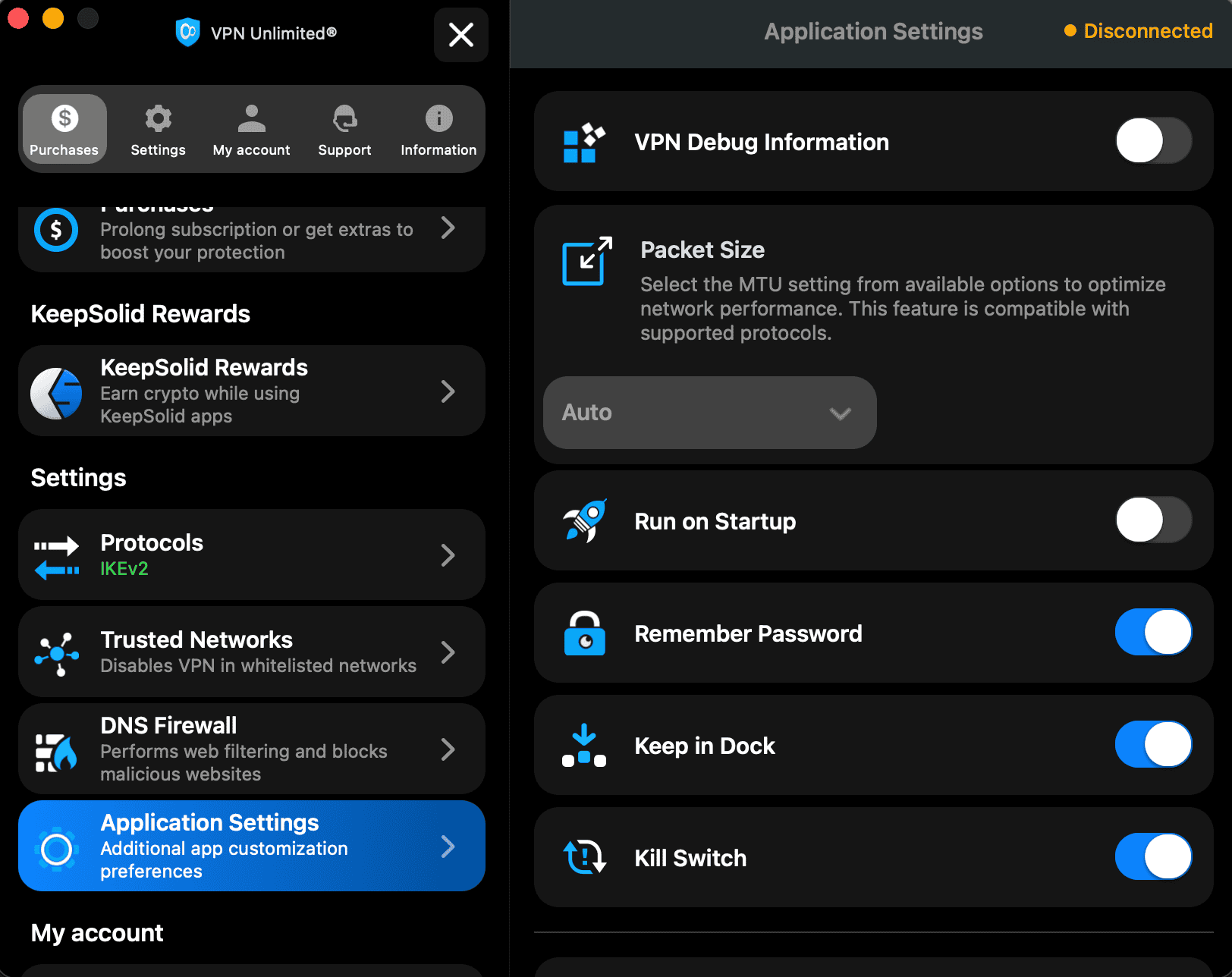
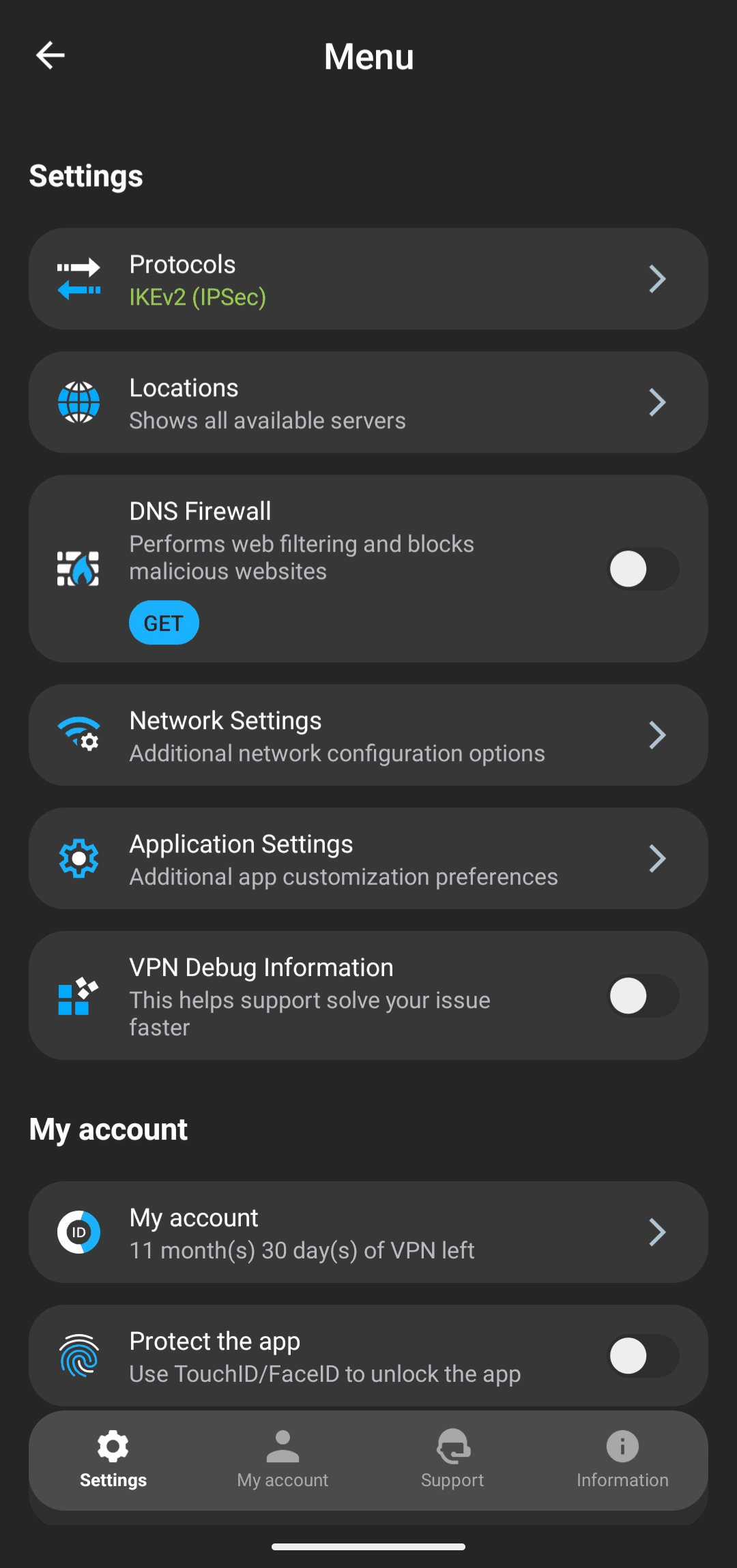
- DNS Firewall: When connected to the VPN, it blocks malicious websites and performs basic web filtering at the DNS level. However, this is not an alternative to antivirus software.
- Kill switch: Unlimited VPN offers a system-level kill switch (blocks all traffic when VPN unexpectedly drops), available on macOS, Android, and Windows. It’s not available on Linux, and on iOS, you can only use the kill switch with the IKEv2 protocol.
- Trusted Networks: This feature automatically disables the VPN when connected to whitelisted networks, such as your home Wi-Fi. We don’t recommend using this feature, since even connections over private Wi-Fi need VPN.
- Split tunneling: Like most VPNs, Unlimited VPN’s split tunneling feature is available only on Android and Windows. This feature lets you route specific apps (e.g. those that don’t work well with VPNs) outside the VPN tunnel, while the rest of your device remains connected to the VPN.
That’s a convincing list of features for a mid-tier VPN, but there are some features notable missing. For example, it doesn’t offer multi-hop routing, which routes VPN traffic through two servers, giving extra privacy and security. It also has no built-in ad blocker, and when creating an account, it requires an email address, making it less ideal for those who are really privacy conscious.
That said, as an everyday VPN, we think VPN Unlimited can do a decent job given its feature set.
User Experience
We’ve given you a rundown of VPN Unlimited’s most notable features, strengths, and weaknesses — all from our hands-on testing. Now it’s time we give you a glimpse of the user experience.
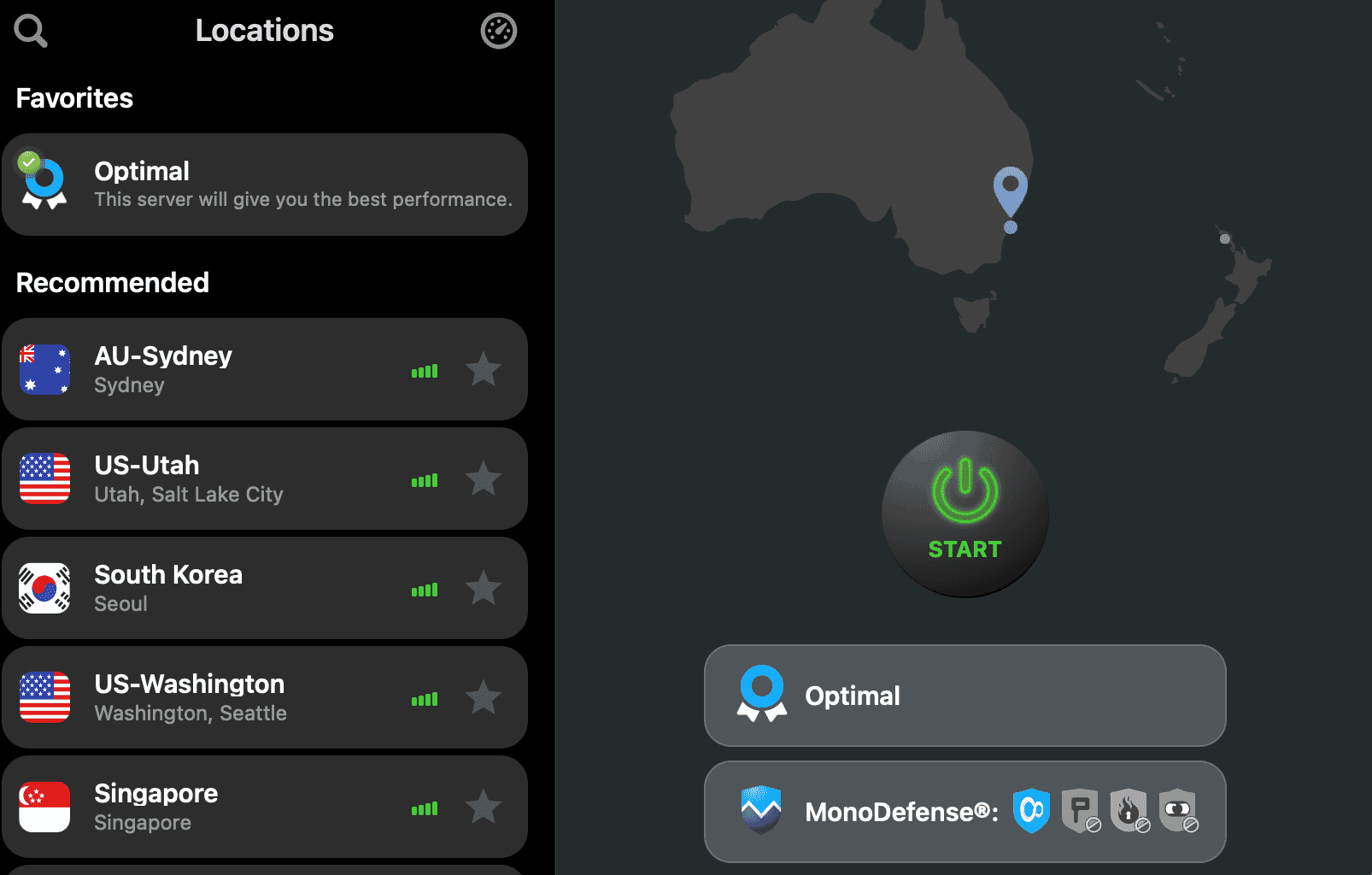
First, the interface. VPN Unlimited’s apps are consistent across macOS, iOS, Windows, and Android, which is a step in the right direction. The settings layout looks nearly identical whichever device we were on, so switching devices didn’t mean relearning a new navigation. We also found the server list organized — there were sections for Favorites, Recommended, General, Torrent, and Streaming servers — which makes finding the right server straightforward.
On macOS, the app connects quickly from the main screen. However, we noticed that while a menu bar indicator confirms the connected state, the taskbar icon gives no visual indication that the VPN is active. We think that’s a minor gap, because you’d have to check the app directly to see if the VPN is running or not. We’ve had smoother experiences with other VPNs; see our macOS VPN recommendation list for more details.
On Android, we also noticed slower connection times. Establishing a connection took about five seconds, compared to around two seconds on other devices. One of our testers noted that the mobile experience lags slightly behind the desktop experience, although we won’t go so far as to say that VPN Unlimited is a better recommendation for desktop users over mobile users.
On the bright side, there’s a ping test feature available to check a server’s ping/latency before connecting. It’s a useful feature, but the icon is small so it’s easy to miss. We also thought the connection error handling was thoughtful. When errors occurred (they did, multiple times during testing), the error message offered a direct link to customer support with the explicit note that real people would respond and not AI.
We actually reached out to customer support. They responded to our initial email in under three minutes, which was impressive, but subsequent replies averaged around 30 minutes. That’s a little slow for urgent concerns, but for email support, it’s actually one of the better response times we got. Some VPNs can take days to respond.
Pricing
You came here to find out if VPN Unlimited is worth it, and we’ve given you almost all the pieces of the puzzle. But one more piece remains — the price. Is the price justifiable for the features and performance we got during testing?
Let’s look at the facts first. VPN Unlimited offers four plan tiers. Three are standard subscription plans; the fourth is a lifetime option, which sounds good, but we don’t recommend it. You’ll see why.
| Plan | Monthly Rate | Billed As |
|---|---|---|
| 1 Month | $9.99/mo | $9.99/month |
| 1 Year | $5.00/mo | $59.99/year |
| 3 Years | $4.50/mo | $161.99 one-time |
| Lifetime | N/A | $5,599.99 one-time |
The monthly plan at $9.99 is actually more competitive than most VPNs. The average price of a monthly VPN plan is around $12 per month, so if you’re going to be paying monthly, you’ll save about $2 per month with VPN Unlimited. That’s about $24 a year in savings.
If you’re planning to go with an annual plan, the $5 per month rate is within industry averages, although there are stronger options at similar prices. NordVPN includes ad and tracker blocking in its basic plan, which runs about $4.50 per month on an annual plan.
As for the three-year plan, we think it’s not worth it. Three years is a long time, and the discount incentive is too small to justify signing up for that long. There are VPNs that cost about $2 per month if you sign up for two years, and these same VPNs made our recommendation list of affordable VPNs.
Lastly, we don’t recommend the lifetime plan at $5,599.99 under any circumstances. Based on the three-year pricing, it would take over 90 years to break even, and there’s no meaningful guarantee the service quality or the company will last that long.
One other downside you should absolutely note is the device limit. All four plans support only up to five simultaneous connections — less than the 10-device limit industry average. You can buy additional device access, but it’s costly. It’s $0.99 monthly to add one device to your account. If unlimited connections matter to you (e.g. if you need a VPN for the entire household), take a look at Surfshark’s plans.
How VPN Unlimited Compares to the Top VPNs
Compared to our highest-rated VPNs — NordVPN and Surfshark — VPN Unlimited competes well in several areas, including speeds on nearby servers and streaming server organization. However, we think it lags behind on privacy credentials (no independent audit yet), performance on long-distance connections, and overall value if you’re looking for a VPN you can use long-term (because of the higher-than-average pricing). Here’s how it stacks up against NordVPN and Surfshark.
| Feature | VPN Unlimited | NordVPN | Surfshark |
|---|---|---|---|
| Starting price (annual) | $4.50/mo (3-yr) | $3.39/mo (2-yr) | $1.99/mo (2-yr) |
| Server Count | 3,000+ in 80+ locations | 9,000+ in 167 countries | 4,500+ in 100 countries |
| Nearby download speed drop | ~5% | ~6% drop | ~9% drop |
| Long-distance speed drop | ~88% | ~22% | ~25% |
| No-logs audit | No | Yes | Yes |
| Simultaneous connections | 5 devices | 1o devices | Unlimited devices |
| Multi-hop | No | Yes | Yes |
| Built-in threat blocker | No | Yes | Yes |
| Dedicated streaming servers | Yes | No | No |
| Money-back guarantee | 30 days | 30 days | 30 days |
VPN Unlimited’s nearby speed performance is exceptional and its dedicated streaming server organization is a genuine advantage. Those are real wins. However, the absence of an independent audit, the five-device cap, and the long-distance speed anomaly are hard to overlook when NordVPN and Surfshark both cover those gaps at comparable or lower prices. Compare NordVPN and Surfshark to find out which alternative option is better for you.
Who Is VPN Unlimited Best For
After testing VPN Unlimited for over four weeks, we’ve come to the conclusion that it’s a decent VPN. It didn’t crack our top 10 this year, but it’s in no way a bad VPN.
VPN Unlimited is best suited for travelers and remote workerswho primarily connect to nearby servers, want a dedicated streaming server list, and can accept the privacy tradeoffs that come with a US-based, unaudited provider. It’s a good day-to-day VPN.
However, we think it’s a poor fit for anyone who needs reliable long-distance speeds, the strongest possible privacy credentials, or more than five simultaneous connections without paying extra. If those needs apply, our recommended picks on the VPN guide will serve you better.
FAQ
Still have questions? We've got answers to the most common queries about KeepSolid VPN Unlimited.
-
Is VPN Unlimited a good VPN?
From an encryption standpoint, KeepSolid VPN Unlimited is safe. It uses 256-bit AES encryption, which is the industry standard for VPNs as well as government and military computers in the United States. From a privacy standpoint though, KeepSolid VPN Unlimited logs more data than we want them to, such as IP addresses, browser versions, and operating systems, so it might not be the best option for those who are conscious about their privacy.
-
Is the KeepSolid VPN Unlimited lifetime subscription worth it?
VPN Unlimited uses AES-256 and ChaCha20 encryption, passed our DNS leak tests across four server locations, and includes a system-level kill switch on most platforms. The main privacy concern is its US jurisdiction under Five Eyes surveillance laws combined with the absence of any independent third-party audit to verify its no-logs claims. KeepSolid discloses that some session-level data may be temporarily collected during active connections. For users whose primary concern is privacy, an audited alternative is more reliable.
-
How fast is VPN Unlimited?
VPN Unlimited’s speed performance depends heavily on server distance. During testing, nearby servers provided virtually zero speed loss. However, long-distance servers caused our internet speed to drop by around 88 percent, which is a bigger drop than most VPNs we test. Users connecting primarily to nearby regional servers will find speeds competitive. Users connecting across long distances should test carefully before committing.
-
Does VPN Unlimited work with Netflix and other streaming sites?
Inconsistently. VPN Unlimited offers dedicated Netflix servers, and these worked in some tests but not others. Standard servers also produced mixed Netflix results. The dedicated Amazon Prime Video server was the most reliable streaming server we tested. BBC iPlayer was fully blocked on both dedicated and standard UK servers throughout our testing.
-
How much does VPN Unlimited cost?
VPN Unlimited’s annual plan costs $5 per month, billed as $59.99 per year. The monthly plan is $9.99, and a three-year plan is available at $4.50 per month. A lifetime plan exists at $5,599.99 but is not a practical purchase for most users. All plans come with a 30-day money-back guarantee and cover 5 simultaneous connections by default.
-
Grand View Research. (2023). Virtual Private Network Market Size, Share & Trends Analysis Report. https://www.grandviewresearch.com/press-release/global-virtual-private-network-market
-
IMARC Group. (2025). Virtual Private Network Market: Global Industry Trends, Share, Size, Growth, Opportunity and Forecast 2025-2033. https://www.imarcgroup.com/virtual-private-network-market
-
KPMG. (2021). Corporate Data Responsibility: Bridging the Consumer Trust Gap. https://assets.kpmg.com/content/dam/kpmg/us/pdf/2021/03/kpmg-corporate-data-responsibility-2021.pdf